

Handle largely up over history, but rate of growth slowing
We’ve now had almost seven years of experience with sports wagering since the in-person betting on athletic contests (and what now includes some other entertainment events) went live on September 1, 2019, followed on October 3, 2019 by online (“mobile”) sports wagering on October 3, 2019.
Since we didn’t even get to experience a full quarter with both forms of sports wagering live for a full quarter in 2019 and Covid impacted the availability of live sporting events in the following quarter – Q1 2020 – and for much of the next year, we’ve only truly had about five years to understand the rhythm of sports wagering in Indiana. Within that context, here’s what we can tell you about the numbers.
With the exception of 2023, the amount of money wagered on sporting events in Indiana has grown over the year since its inception despite, for example, changes in the market which have led to our neighboring states of Illinois, Kentucky, and Ohio also adopting sports wagering laws.
The rate of growth, however, has been diminishing as the industry has matured, even as, for example, we’ve seen phenomena such as the tremendous playoff runs of the Indiana Fever and the Indiana Pacers, the early season success of the Indianapolis Colts, and the undefeated football season for the Indiana University Hoosiers, and the Big 10 Football championship game in Indianapolis between teams from Indiana and Ohio.
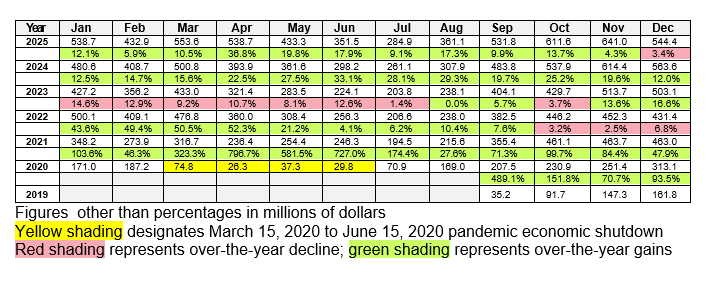
You will also note that over-the-year growth by month has been the rule, rather than the exception. Save for a 12-month stretch in 2022-2023 (largely impacted by changes in neighboring states), we’ve only seen two over-the-year declines in monthly sports wagering, and just one of those has come since late 2023. Unfortunately, that month was the final month of 2025, ending the most recent year on a down note (December 2025, however, had one fewer Sunday than in 2024).
This does not appear to be a one-month aberration; January 2026 handle of $523,409,708 is down from $538,705,451 in January 2025, despite Indiana University playing in the Rose Bowl, Peach Bowl, and national championship football games in January 2026. The last time we had seen back-to-back over-the month declines in handle was way back in the summer of 2023.
Putting it colloquially, the spots wagering handle is a small drop in a big Hoosier gaming bucket. Placing the sports wagering handle into perspective, the 2025 handle of $5.823 billion from a full year of sports wagering is the equivalent of about 3.5 months of slot handle at the 13 commercial casinos; slot machines produced $5.053 billion in the final quarter of 2025, following $5.226 billion in Q3.
Add the $21 billion or so in slot handle to about $1.8 billion in annual table drop, and the $23 million or so casino equivalent of the $5.8 billion of sports wagering volume runs about four times higher – and the approximate one-third effective state and local tax take from the casino win is considerably higher than the 9.5% state tax on sports wagering win.
We’re not going to delve back into over-the-year changes in gross gaming revenues, but Indiana’s GGR improved over the year in each month of 2025 until declining in December. Gross gaming revenue grows by 11.7% over 2024 levels in Indiana, precisely the same growth rate as sports wagering analyst Alfonso Straffon (whose numbers we largely used for the historical data above) – although he notes that same-state total numbers see GGR rise by a smaller 10.2% over the 2024 levels.
Indiana’s 2025 presumptive hold level improve from the prior year in seven of the 12 months of 2025. That’s the same number of months as the national average – and the same exact months as well. Indiana ends 2025 with an average 10.1% hold rate, remarkably also spot-on the national average improvement Indiana grows by 76 basis points from 2024 versus an average annual bump of 87 bps.