
If ex-GOP mayor wins SoS ballot slot, Libertarians could lose shot
Business and marketing entrepreneur Lauri Shillings (L) of Carmel gains the Libertarian Party of Indiana nomination for secretary of state, the first of potentially four candidates to secure ballot access for a fall donnybrook – preceded by some major intramural battles before the real games begin in what will be the marquee statewide race on the ballot this year.
Shillings, who received 2.7% of the vote in 2024 as the LPIN nominee for the CD 05 seat becomes this cycle’s Libertarian sacrificial lamb, entering a race with no expectation of winning. Look at the race through this prism: the top LPIN vote-getter in history was its 2020 nominee for governor, who capitalized on a Republican governor unpopular with his base, and an underfunded and largely unknown Democratic nominee to gain 11.4% of the vote . . . with about seven percentage points not due to himself or his party, but rather shortcomings of the major party nominees. Case in point: when that same candidate, Donald Rainwater (L), ran in 2024, he earned only 4.6% of the vote.
Graphic designer Shillings faces both an important and tall task this cycle, however, because she must receive at least two percent of the vote for LPIN to earn automatic ballot access for statewide and federal office going forward. This typically would not be a problem, as the numbers indicate:
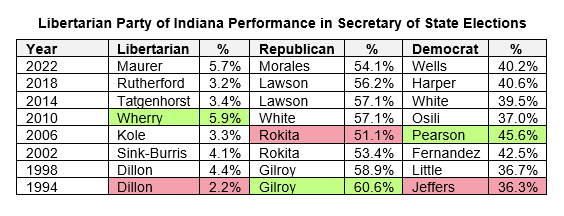
Since gaining ballot access in 1994 (when attorney Steve Dillon (L) was most identified with marijuana legalization – before that issue became a mainstream phenomenon), Libertarians have averaged about 4.0% of the vote in a given three-candidate contest for secretary of state.
LPIN candidates have ranged from a low of 2.2% (in 1994) to a high of 5.9% in 2010, and 5.7% in the most recent contest, when neither major party’s nominee attracted enthusiasm outside their respective bases.
Yet this year’s election will be anything but ordinary.
Hoosiers are looking at a highly anticipated general election contest that most currently expect will be fought out between Secretary of State Diego Morales (R) and the Next Great Democratic hope, Beau Bayh (D). Since the advent of LPIN ballot access, we’ve never had two highly recognizable, well-funded figures oppose each other in the general election – particularly names as polarizing or galvanizing (in each direction for each candidate) as Morales and Bayh. Former Marion County clerk Beth White (D) and former Bloomington mayor John Fernandez (D) had discrete constituencies, but their respective races were certainly not barn-burners (and Todd Rokita (R) had yet to run for public office before his 2004 face-off with Fernandez).
There is also a crowded field for the two major party SoS nominations at this point, with delegates to be elected in May.
Secretary Morales, Knox County Clerk David Shelton (R) unsuccessful 2024 primary candidate for governor (and later a lieutenant governor who didn’t go to the convention gate) Jamie Reitenour (R) are currently pursuing the Republican nomination; former mayor Ballard is seeking petition signatures for ballot access; and attorney Bayh and small business owner Blythe Potter (D) are in the mix for the Democratic nod.
Shelton and Potter are running aggressive campaigns against the putative frontrunners, and a Shelton upset cannot be ruled out, particularly if Reitenour can peel away some of the Morales base, which is comprised of (what has, over the past six to eight years, turned into) the core GOP convention crowd. We’ve not heard any murmurs yet about the composition of the crowd that filed for delegate, but the key will be which candidate can get his or her delegates elected in May. Morales has proven to be a master at this, and Shelton now has experience under his belt from his 2022 run against Morales, and has also broadened his network. Reitenour has not yet run a convention race, and continues to confound most observers with her nontraditional campaign tactics (which may play better in a primary than a convention setting).
Potter continues to travel the state and insists that she’s in it to win it against Bayh in convention, but that’s an extremely heavy lift . . . albeit one that could attract a number of progressives. Like the GOP base has become more hard core, so too are Hoosier Democrats – at least the activists – starting to move to the progressive end of the spectrum, convinced that the old Evan Bayh-Ohio River-moderate-fiscal conservative Democrat model hasn’t played well to voters in decades and is out of touch with millennials and Gen Z voters. This may be the final cycle in which Democrats fight the internal battle over the direction of their party on a statewide basis (and if Bayh wins the nod, that can is only kicked down the road, and it is not necessarily a battle won). Top Ds continue to try to persuade Potter to switch her focus to a race for state treasurer or comptroller, but to no avail – at least so far.
Assuming the conventions play out as anticipated, the last time Indiana had such high-profile, fully funded names running against each other or secretary of state would have been then-secretary of state Joe Hogsett (D) challenged by then-Indianapolis mayor Bill Hudnut (R) in 1990 . . . and a then-30-year-old Evan Bayh (D) running for his first office in 1986 against Rob Bowen (R), son of former Gov. Otis Bowen (R).
So in a name with two big, well-funded names, there may not be a lot of runway for the LPIN nominee – whose best hope might be to siphon off votes from Hoosiers who simply can’t stomach either of the major party nominees. Ordinarily, this wouldn’t be a problem, because two percent of the vote isn’t a particularly high threshold to mount, even in the most hotly fought race on the ballot.
But – oh, yeah – there’s a potential added variable this year. Former two-term Republican Indianapolis mayor Greg Ballard is also running for secretary of state . . . but as an independent seeking the Lincoln Party imprimatur (assuming he can wrangle some 37,000 valid petition signatures). The old Ballard political brain trust, a Republican crew which helped him to an unexpected upset win in 2007, and guided him through two terms that first made him an easy winner of reelection in 2011 and then as a well-liked figure as he left office 11 years ago, is stoking his campaign fires this year, along with Nathan Gotsch of Allen County, who sees Ballard as the vehicle to gaining prominence for his favored independent movement.
Ballard views ballot access under the Lincoln Party label as a means of facilitating future access for independent candidates under an umbrella that would allow them to forego the need to collect some 40,000 signatures (a threshold likely to grow because a heated SoS race this year should attract more votes, and this race will be the one on which the 2028 signature count is predicated).
Bear in mind as well that Libertarian Shillings is likely to also be the least well-known of the four likely candidates on the November card, and should Ballard gain ballot access, his campaign will likely become a media darling, further sucking any oxygen (and votes) from the Libertarian effort to siphon votes from the two major party hopefuls.
Bottom line: Shillings will face an uphill, fight in maintaining LPIN automatic ballot access for future elections should Ballard achieve his immediate goal of being added to the fall ballot.