

How the candidate elections may impact the 2027 session
As the General Assembly prepares to consider assorted significant gaming issues in the 2027 legislative session, one of which may be whether to fashion an “underserved market casino alternative now that Northeast Indiana has turned its thumbs down on the concept, a substantial number of lawmakers – 28, to be precise, 14 in the House and 14 in the Senate – have a vested interest of sorts, given that their respective districts are home to at least one existing gaming facility. Two senators and two House members also hail from districts with multiple commercial gaming operations.
Two years ago we told you that many of them were not among the more senior members of the legislature, and even those who are beyond their respective first terms, few had much experience at all. Some now have some legislative experience under their respective belts, only three are brand new this year, and with the huge wave of new lawmakers entering the General Assembly after the 2026 election, even those lawmakers are among the more senior cadre now.
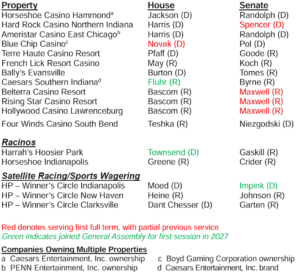
An interesting fact now that casino gaming has been the public policy of the state for 33½ years now: Only one lawmaker whose district includes a gaming facility, Sen. Lonnie Randolph (R) of East Chicago, was a member of the General Assembly when casinos were authorized in 1993 – and his service since has been non-continuous.
Only Sen. Vaneta Becker (R) of Evansville, Sen. Mike Young of Indianapolis, and Sen. Jean Leising (R) of Oldenburg – the mother of charity gaming – were lawmakers in 1993 when the casino bill was passed. Sens. Becker and Young were in the House then; Sen. Leising (like Sen. Randolph) has not had uninterrupted service in the Senate since 1993.
On the House side, Rep. Sheila Klinker (D) of Lafayette; Rep. Greg Porter (D) of Indianapolis, Rep. Vernon Smith (D) of Gary, and Rep. Vanessa Summers (D) of Indianapolis are the sole House members still serving who voted on the 1993 organic measure.
Indeed, the 2025 session was the first with a lawmaker born the same year the first Hoosier casino vessel hit the water.
As we noted as 2025 opened, turnover across late 2023 and 2024 and then the November 2024 election resulted in a number of new lawmakers in 2025 with little or no experience – more than this year. That phenomenon can potentially prove problematic for communities seeking to defend their properties . . . or play a significant role in the process of a license transfer or addition, both in terms of understanding the importance of the historical context, and how they can best impact the policy process through legislative maneuvering.
There are 11 commercial casinos and two racinos; one Native American casino; three satellite wagering/sports wagering facilities; and whispers suggest that one additional site – in Indianapolis – might be under consideration in 2027 now that the Allen County, DeKalb County, and Steuben County voters have firmly rejected what may well be their only opportunity to land a land-based casino license.
A potential new site in Indianapolis could add solons from another three or more districts with a direct vested interest in landing a license, as well as those from adjacent districts who will want to share in the largesse, but avoid any of the perceived problems. We’ve already seen a bipartisan coalition form behind Sen. Aaron Freeman (R) and Sen. Greg Taylor (D), both of Indianapolis, behind a potential Circle City casino . . . and we’ve mentioned Speedway (and The Speedway as a potential site as well).
We’re now talking about 33 or so of the 150 lawmakers – approaching 25% – whose districts now have or could potentially be impacted by legislation creating a new or moving an existing casino license. Obviously, facilities operated by Caesars Entertainment, Inc. in Anderson, Indianapolis, New Haven, and Shelbyville would be hit hard by a new casino in Indianapolis, and those representing districts with those operations (and with significant ag-equine interests) would be heavily involved in defending them . . . and that’s still not the full extent.
Consider that even if a current host community such as Terre Haute, Evansville, or Harrison County might not seem to be directly affected by such a change, an existing operator in one of those or other areas might be interested in competing for an additional or transferred license, bringing the issue home when it might not have otherwise seemed quite as relevant. Note as well, that it might be more than one existing operator interested in making such a play for a license in a lucrative new market, bringing even more lawmakers to the table.
Of the 16 districts with gaming properties only two are home to senators who are serving in their respective first full terms in the 2027 session . . . although one of those senators has additional partial years of service to his credit. Only three of the 16 House districts will be represented by House members in their respective first full terms in 2026 – each experiencing at least their first full budget session.
Some of the new lawmakers are also Democrats, which means that they will be swimming upriver, but the break in the Republican supermajority in the November election will change some of that dynamic . . . and we’ve also learned that gaming legislation has not proven to be a partisan matter over the past three decades.
On the House side, eight of the 17 properties will be represented by majority Republicans; 11 of the 17 gaming districts on the Senate side will be represented by majority Republicans – and the new Senate president pro tem and Senate majority floor leader each hail from districts with gaming properties. There has been considerable change over the past few decades from the time when the so-called “riverboat” districts were largely represented by Democrats.
The new chair of the Senate Committee on Public Policy, Sen. Justin Busch (R) of Fort Wayne, does not have any gaming properties in his district, nor will he thanks to the defeat of the Allen County casino referendum (he represents parts of Allen County and all of Whitley County). No chair of the Senate public policy panel has ever represented a district that was home to a casino (but in the 1990s, the panel’s then chair may have represented the satellite wagering facility on the north side of town.
For the first time, a lawmaker – Rep. Scott Fluhr (R) of Corydon – is a full-time, long-time employee of a casino operator, a human resources analyst for Caesars Southern Indiana.
There may be an important bottom line here as we move further and further from the days when gambling was first authorized in the form of the Hoosier Lottery and pari-mutuel horse racing in 1989, almost 37 years ago. The mindset on gaming has shifted significantly from even almost eight years ago, during consideration of the last omnibus bill that authorized sports wagering and the transfer of a license from Gary to Terre Haute. Back in the Day. Even just a few years ago “expansion” of gaming was a pejorative term employed to try to derail a given policy initiative.
The attitude is different today as we start to see more lawmakers who have grown up with legalized gambling as the public policy of the state. In the last session, the youngest lawmaker serving was born after the first lottery ticket was sold, and in the same year as the first riverboat casino began operating in Indiana. Today, the youngest member is Rep. Lauren Cole (D) of Fishers, by her estimation, the first member of Gen Z to serve in the General Assembly.
Rep. Cole knocked off the sitting speaker of the House, then- Rep. Todd Huston (R) of Fishers. Her campaign website this week tells her story: “At just 29 years old, Lauren is the first openly lesbian woman elected to the Indiana General Assembly, the first openly LGBTQIA+ person elected to the Indiana House of Representatives, and the first member of Generation Z elected to the Indiana House. She is also the youngest member of the incoming Indiana House.” By the time she was born in August 1997, seven riverboat casinos were operating along with the one pari-mutuel track. Even the chair of the House Committee on Public Policy has lived his full adult life with the original complement of 10 casinos, French Lick, and two racinos in operation.
During a committee hearing on a gaming agency bill in early 2025, Rep. Kyle Miller (D) of Fort Wayne, now in his third term, sought to add a broad iGaming legalization provision to the measure being reviewed. He reminded colleagues, “[W]e’ve said we’re a gaming state. I agree with that. We decided that 30 years ago.”
As gaming becomes more ingrained in the social fabric and communities of the state (as former Gov. Eric Holcomb (R) observed to us in an interview as he ran for his first term in 2016) attitudes change, revenue opportunities become clearer, and the ability to combat any negative societal impacts improve, it seems as though the focus of the discussion on gaming bills has shifted from one eschewing “expansion” to a perspective shutting out competition (in the form of sweepstakes games and video gaming terminals, for example – and perhaps prediction markets in 2027 – and shoring up our existing markets and embracing assorted new gaming opportunities that don’t infringe upon Indiana’s golden goose.