
Associations seek quicker state backfill for gas tax losses
As Governor Mike Braun (R) weighs whether to extend his unilateral suspension of the gasoline use tax and excise tax for another 30 days into early August, local governments are looking for reprieve from roughly three months’ worth of lost revenue from fuel taxes.
You may recall that earlier this month, when the Governor offered the latest extension of his self-labeled “Braun Gas Tax Holiday,” he revealed his intention to reimburse local governments for their portion of lost revenue from the use and excise taxes. But he was not sure exactly when that reprieve would come.
There still is not a solid timeline or memo outlining next steps for locals. However, the Governor’s Office informs your favorite transportation newsletter at mid-week that the hope is to provide a reimbursement this year . . . and not leave the locals hanging until legislators return for the legislative session in 2027.
We’re told, “Governor Braun is exploring every available option under his executive authority to reimburse local governments before the end of the calendar year.”
Organizations representing local governments, including the Association of Indiana Counties (AIC), the Indiana Association of County Highway Engineers and Supervisors, and Accelerate Indiana Municipalities (Aim), are taking the lead on seeking what could be a more immediate solution to backfill local coffers as governments prepare for the first hit from the suspensions in July.
The local government associations sent a request to the Indiana State Board of Finance this month proposing the board use its authority to transfer funds to backfill local governments as soon as July for the local disbursements that were expected from the gas use tax beginning in April, and the excise tax from May on.
AIC Executive Director David Bottorff says commitment or an assurance for relief this summer from the board would provide some peace of mind to county governments, who are assessing how revenue will be affected by the months-long gas tax suspensions.
“The easiest thing to give us the most comfort is if the revenue continued to flow monthly like it does now,” Bottorff explains. “I know the Governor mentioned in the press conference he didn’t want to see any projects not go forward because of the sales tax holiday.”
Bottorff continues, “For us to feel comfortable, and our members to feel comfortable, if the thought is, wait till the General Assembly comes back in January, it is difficult for our members to spend money out of reserves, anticipating that the General Assembly may replace the money – or the Board of Finance, we feel like, could take action now and keep our revenue stream flowing.”
The timeline matters because the effect of the suspensions at the pump has not immediately shown up in local road accounts, but real impacts will begin in July, AIC believes.
The gasoline use tax, a 7.0% sales-equivalent tax on gasoline, was first suspended April 8. Gov. Braun expanded the relief May 6 to include the 36¢-per-gallon gasoline excise tax. Though drivers saw the tax relief immediately, fuel sales are reported to the Indiana Department of Revenue the following month, processed by the state, and then distributed to local governments about a month later. So, for example, June distributions reflect May revenue, based on April driving, and May activity appears in the July Motor Vehicle Highway (MVH) reports.
Local governments are only now beginning to see the impact in Motor Vehicle Highway and Local Road and Street fund distributions.
June distributions reflected only a partial month of the gasoline use tax suspension and no interruption in excise tax collections. The more substantial impact will arrive in July, when distributions reflect a full month without gasoline use tax collections and about three weeks without excise tax collections. August distributions are set to reflect a full month without either tax.
The gas use tax and gas excise tax together account for roughly half of total excise distributions, though those distributions also include about 23 other transportation-related taxes and fees. In other words, the money will not vanish entirely from local road accounts, but the loss could be significant at precisely the point when counties, cities, and towns are in the middle of construction season and beginning to assemble 2027 budgets.
Under the normal statutory formula, approximately 62% of Motor Vehicle Highway Fund money is directed to the Indiana Department of Transportation, 25.87% goes to counties, and 12.13% is distributed to cities and towns. The Local Road and Street Fund sends about 63% to INDOT and 37% to local governments.
The local associations’ request to the State Board of Finance is intended to avoid requiring counties, cities, and towns to absorb that gap while waiting for a possible end-of-year reimbursement or action by lawmakers next year. The groups are asking the Board of Finance to use its authority under Indiana Code 4-9.1-1-1 through 9 to transfer available state funds and continue local distributions using the established Motor Vehicle Highway and Local Road and Street allocation formulas.
Bottorff believes the Board of Finance – which is comprised of State Budget Director Chad Ranney, State Comptroller Elise Nieshalla (R), and State Treasurer Daniel Elliott (R) – has the flexibility to act through reversions, surplus revenue, or other appropriated money that has not been obligated.
AIC’s preferred outcome would be for the board to make up the partial gasoline use tax loss in July, and then continue replacing the local shares of the suspended taxes as they would have been distributed.
That would afford local officials more than a promise of eventual reimbursement. This method would provide a cash-flow mechanism during the period when they are awarding contracts, maintaining roads and bridges, paying highway employees, and deciding whether they can commit money to late-summer and fall projects.
Without certainty on when coffers will be backfilled, it may be difficult for local leaders to continue spending as usual, knowing reimbursement will be coming eventually.
“There are some who may not let contracts out for projects here in the late second half of the summer into the fall,” Bottorff predicts. “I think many of them are looking at their personnel that are often paid for out of the gas taxes for the county highway departments, so members are still continuing to look at those solutions on hand to handle this decrease in revenue.”
He reiterates a commitment from the Board of Finance or the Governor’s Office that funds will be replaced on a defined schedule could prevent those pullbacks.
“If they could take action or give us an assurance they’re going to take action. I think we could continue our projects and our personnel change,” Bottorff asserts. “But without some type of further discussion or assurances on when the money will be replaced. I think counties will start to pull back.”
Aim CEO Matt Greller informs us a majority of cities and towns have not yet broadly reported canceled projects or major service interruptions. But he suggests the lag in the distribution system simply means the more difficult decisions may still be ahead.
“We haven’t seen any huge delays yet, or major service interruptions, but those dollars lag,” Greller explains. “So our folks are just now starting to see the decrease, and obviously I’ve talked to cities and towns out there that are definitely waiting to see where this heads, and before they make any more big decisions, but hopefully we can avoid any construction season interruptions and get that maintenance work done, like, like we need to.”
The tax suspensions also arrive as local governments are contending with the effects of changes to property taxes under SEA 1-2025, Greller points out. The fuel tax losses may thus be more consequential than a temporary interruption might have proven on its own.
“There is certainly concern about the reduction in revenue, you know, there’s been a lot of other conversation around local government funding over the last couple of years, and there have certainly been some cuts to property taxes that are being felt by local folks as well,” Greller expands. “So I think, you know, when you combine that all together, that’s creating more of an issue this time around than maybe just a moratorium on the gas tax would have caused, in a standalone scenario … it’s compounding, I guess, the impact, so that’s why we’re so hopeful that it could get it backfilled.”
Concerns also extend beyond those individual local paving and bridge projects. The tax revenue also supports the statewide transportation funding structure that underpins programs such as Community Crossings, which provides matching grants for local road work. “That money flows into everything. It’s really important,” Greller notes.
Lower local cash balances could also make it more difficult for communities to provide the required match for Community Crossings grants.
Both Greller and Bottorff recognize the rationale for saving Hoosiers money with the tax suspensions, and a state backfill remains less a question of whether it will happen and more of how quickly the state can settle on a mechanism.
Greller is confident the Governor will hold to his promise to make local governments whole. Conversations with the state have been positive, even without a timeline in place yet, he says.
“We want to see, you know, the state use whatever means they feel is best to replace that lost revenue from the gas tax,” Greller states. “Fiscal outlooks look good for the state. I would say, you know, preliminary conversations with the Governor’s Office and others have gone well. I think everybody is in full support of infrastructure funding; everybody’s just trying to balance … high cost for residents and drivers, etc., with infrastructure needs.”
Still, local officials are looking for something more concrete than positive conversations. A commitment to restore the money before the end of 2026 would ultimately help local budgets, but it does not answer whether counties, cities, and towns should spend reserves this summer, postpone projects, or wait for direction before bidding work.
“I have not heard from anybody exactly that has said we’re going to delay this project or cancel this project,” Greller divulges. “I do know that once this hits in July, and if there’s not a plan to backfill it, that will start happening.”
He continues, “You know, we just have too many folks that depend in some cases almost exclusively on these distributions for their road maintenance and road repair budgets, so if we don’t have clear direction here in the next few weeks, I would be almost certain that you will see project interruption.”
There are a few areas where this uncertainty is shaping local decisions. Carson Gerber reports for Free Press Indiana News that Fulton County could lose up to 40% of its road revenue, and county officials have cut 15 miles of paving work and reduced planned chip-and-seal work by half. Another example, Gerber finds in Miami County that the highway department is delaying the purchase of a replacement dump truck, raising the prospect of a more expensive backlog later.
For Bottorff, the Board of Finance request is designed to make the scenario of cutting or pausing planned projects and transportation-related expenditures less likely by converting the Governor’s stated commitment into a more immediate revenue stream.
“We’re hopeful that the Board of Finance will consider this request and talk to the Governor and legislative leadership to see if they feel like this is an appropriate avenue to replace the money,” Bottorff expresses.
The State Board of Finance meets next on June 30, but the board does not intend to take up the request, a spokesperson for the Office of the State Comptroller informs us. The board has received the associations’ request and is reviewing the ask.
However, the comptroller’s office explains that the timing of any Board of Finance action is driven by the delayed reporting of fuel tax collections. As we mentioned earlier, the state receives gas tax revenue one to two months after the fuel is sold, so the full effect of Gov. Braun’s tax suspensions will not be visible in MVH revenue reports until later this summer. With that in mind, the office states, “until those deposits are made, the state cannot fully calculate the lost revenue that would need to be replaced.”
Thus, the comptroller’s office explains:
With this timeline, the data that shows the effects of the suspension is not yet available, so the request is not on the June 30 agenda for the State Board of Finance. Staff are continuing to monitor the revenue‑reporting schedule and will work toward identifying an appropriate future meeting as the data becomes available. We will keep the associations updated as the Board determines its next steps.
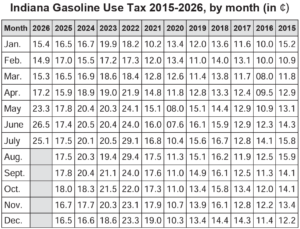
All these discussions are taking place as the numbers are in for the July gasoline use tax rate. Based on the Indiana Department of Revenue determining that the retail price per gallon of gasoline was $3.591 for the period from May 16 to June 15, the gas use tax works out to 25.1¢ per gallon for July (an even quarter when rounded down under law).
While this is down by 1.4¢ per gallon from June (and down for only the second time from the prior month during 2026 to date), it is 7.6¢ per gallon higher than one year earlier, and is not only the second highest amount of the year (trailing only the June tax, it is the second highest ever for any month of July. We now have faced a gas sales tax greater than 20¢ per gallon for three straight months (albeit tolled), the first such consecutive run since the third quarter of 2024. This is also the highest total for the tax for any three successive months since the second half of 2022.
If you parse the gas use tax chart below that we prepare each month, you’ll see that June and July typically feature the highest taxes of the first seven months of the year, and since 2020, only once has the tax declined from July to August, suggesting that taxpayer savings – and foregone revenue for roads – will only grow next month.
Another concern: the highest ever gas sales tax was recorded during the month of August, 29.4¢ per gallon back in 2022. The Gasoline Excise Tax will likely also bump up by a penny to 37¢ per gallon on July 1.
Gov. Braun had indicated when he extended the tax holiday through the beginning of July that he would likely tack on a final 30-day extension through August 7. As of mid-week, he has not decided on extending, and you can likely expect an announcement next week before the Independence Day holiday weekend.
The pressure to extend the tax holiday could depend on whether the recent retreat in fuel prices holds. Still, reinstating the gas taxes would cause sticker shock after the holiday weekend, likely pushing prices at the pump back above $4 per gallon. Another 30-day suspension would “save” Hoosiers around 61¢ through July, which is currently about the difference between Indiana’s average gas price per gallon and the national average price.
Indiana continues to hold the nation’s lowest average gasoline price at $3.32 per gallon, according to AAA data on Wednesday, and the national average fell over the past week to $3.92. The national average price is down nearly 60¢ from a month ago, when the average reported price was $4.51 per gallon. Indiana’s average gas price a month ago was $3.93/gallon.
Gov. Braun on Wednesday afternoon celebrates “one month of cheapest gas in the country,” with his office crediting his executive suspensions of the state’s gasoline taxes for saving Hoosiers about 62¢ per gallon at the pump.
“Affordability is my top priority. Since I suspended Indiana’s gas taxes, Hoosiers have had the cheapest gas prices in the country,” Gov. Braun lauds. “Those savings are a big benefit for families trying to make ends meet at the kitchen table. Making life more affordable for Hoosiers will always be priority one.”
Indiana’s average diesel price also dropped 22.2¢ during the week, from $5.44/gallon to $5.22/gallon Wednesday. But diesel is not affected by the current fuel tax suspensions.
The general decline in gas prices follows a pullback in oil markets, with West Texas Intermediate crude falling to $75.88 per barrel in early Monday trading, down from $80.16 one week earlier. But GasBuddy analyst Patrick De Haan warns in an interview with WANE-TV in Fort Wayne that the outlook remains unsettled amid renewed uncertainty involving Iran, the Strait of Hormuz, and the possibility of further U.S. military action.
If the Governor wants to continue boasting the lowest gas prices in the country, at least for another month, he is likely to soon extend the suspensions through August 7. But as motorists continue to benefit at the pump, local governments are still waiting to learn when – and how – the state will make them whole, and whether they can afford to keep repairing the roads motorists rely on this summer. That answer may not come as quickly as another extension.