
INDOT lays out sobering road cost, revenue report at BudCom
Anyone following Indiana’s road infrastructure discussions in recent years knows the state is heading toward a major funding problem . . . one that extends far beyond the roughly $1 billion hole to be created by suspended gas taxes for most of this year.
That funding cliff may also arrive sooner than previously projected.
Indiana Department of Transportation Commissioner Lyndsay Quist, at the end of August, painted a concerning picture of Indiana’s road funding future, as rising construction costs and weakening fuel tax collections leave the department with a diminished ability to maintain and expand the highway system.
Quist laid out that longer-term problem during an August 27 presentation to the State Budget Committee, where lawmakers focused heavily on the growing cost of highway construction and the agency’s projection that, without additional revenue, it could reach a point in the early 2030s when available funding is no longer sufficient to meet statutory road-maintenance requirements.
Among the figures drawing the most attention is INDOT’s estimated average cost to rehabilitate an interstate lane mile, which has skyrocketed from $8.4 million in 2015 to $46 million in 2026. The average cost reached $10.1 million in 2018, $19 million in 2021, $20 million in 2022, and $44.9 million in 2024 before climbing to $46 million this year.
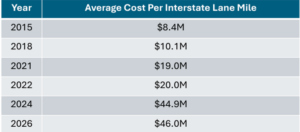
INDOT notes that the estimates do vary by project location, terrain, and complexity and do not include change orders.
Those numbers startled the legislators on BudCom (as well as the general public, which expressed shock as the table swiftly made rounds on social media).
“I think it’s incumbent upon us when we see something stunning to pay attention to it,” Rep. Ed DeLaney (D) of Indianapolis remarked about the lane-mile costs. He questioned, “In 2015, you could lay a lane of interstate one lane one mile for $8 million. That’s just one lane of maybe four or six, right? And now it’s 46 (million). What happened?”
Commissioner Quist pointed to several years of rising construction prices, including a substantial increase between 2018 and 2021, followed by another period of significant cost growth in 2022 and 2023.
She also noted that more than 80% of INDOT’s capital program is competitively bid, with low bids generally winning under state law, although the agency can use alternative project-delivery methods and other approaches intended to control costs.
INDOT has begun examining how Indiana’s costs measure up with other states, although Quist did not have those comparisons available for the committee. She told lawmakers that conversations with transportation officials in other Midwestern states indicate they are experiencing similar increases in project costs.
A cost of $46 million per lane mile is particularly sobering when looking at INDOT’s projected revenue growth. The department’s revenue is not growing at the same pace, leaving the agency able to purchase less construction with each transportation dollar even before the state accounts for this year’s suspension of gasoline taxes.
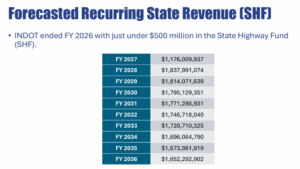
Indiana last overhauled its road funding system nearly a decade ago through HEA 1002-2017, which increased fuel taxes and established or expanded several transportation revenue sources. Quist credited that legislation with allowing the state to complete major projects and improve road and bridge conditions, but she told the committee that inflation in 2022 and 2023 significantly reduced the purchasing power produced by that package.
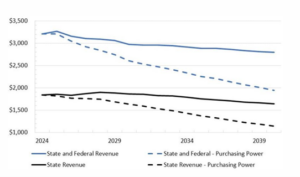
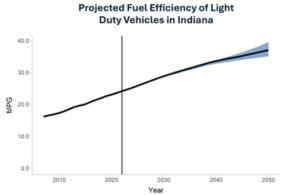
The pressure on revenue also is impacted by changes in the mix of vehicles using Indiana roads. INDOT reports that the average fuel efficiency of light-duty vehicles in Indiana has improved by about 15% since 2017, and the agency projects average efficiency could increase from about 24 miles per gallon in 2023 to 37 miles per gallon by 2050. More efficient gasoline vehicles require fewer trips to the pump . . . while electric and hybrid vehicles (whose purchases via loans may have been significantly incentivized by tax savings under the One Big Beautiful Bill Act ) reduce gasoline consumption – and thus taxes – further.
Registration fees on electric and hybrid vehicles provide some replacement revenue, but Commissioner Quist informed BudCom those collections remain small compared with what the state receives through fuel taxes. She presented the agency’s long-range projections as a forecast of how transportation funding could change as fuel efficiency improves, electric-vehicle adoption increases and construction costs continue to consume more of INDOT’s budget.
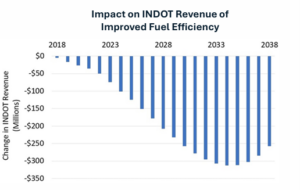
State and industry leaders have known for a while that fuel taxes are not a long-term funding mechanism, for the reasons Quist presented, and the fact that fuel taxes continue to lose to ability to keep pace with inflation.
Sen. Fady Qaddoura (D) of Indianapolis, the Senate Democratic fiscal leader, questioned Quist about previous INDOT projections showing when transportation revenue might become inadequate to meet the agency’s statutory maintenance requirements.
Earlier discussions had placed that tipping point around 2034 to 2036, but Quist acknowledged to Sen. Qaddoura that INDOT’s modeling now suggests it could arrive sooner because of several factors affecting both revenue and purchasing power.
“We would see potentially sooner than 2034 or 2036, potentially closer to 2033 or ’32, us not being able to meet our statutory requirements,” Commissioner Quist revealed, adding that the estimate could change if Indiana develops another source of transportation revenue, including interstate tolling.
Quist declined to commit to a specific year without following up with additional information, but Sen. Qaddoura argued that whether the date falls in 2032, 2034, or several years later does not change the larger issue confronting legislators.
“The idea that I’m getting at is that the General Assembly has to act if we see a red flag that the state agency that is responsible for maintaining state highways and roads is reaching a point in the next decade,” Sen. Qaddoura remarked.
POLITICO reports Thursday that the federal “Highway Trust Fund is nearing insolvency due to increased fuel efficiency in vehicles, slowing annual growth in miles driven in America, and Congress failing to either raise the taxes or cut spending. The trust fund is projected to be exhausted in 2028. A transfer from the Treasury Department’s General Fund will likely be needed to prevent a shortfall.”
INDOT is not yet confronting widespread deterioration across the system. The agency reports that 94.1% of state road pavement was in fair or better condition in 2025, with 97.5% of bridges meeting that standard, although Quist connected the recent leveling of road condition measurements with the loss of purchasing power as construction prices rise.
The concern is that maintaining those standards becomes increasingly difficult when the revenue available for preservation remains relatively flat and the cost of each rehabilitation project continues to rise, which could eventually force INDOT to devote a larger share of its budget to maintaining existing highways . . . and leave less cash available for capacity projects or new construction.
For further context, as we reported in our last issue, Brian Gould, executive director of Build Indiana Council, expects those choices could appear well before INDOT reaches the point where its models show it struggling to meet statutory requirements. Indiana transportation revenues had already largely plateaued by 2024 and showed little meaningful growth in 2025 or 2026, even before the gas-tax suspension reduced collections, while construction inflation remains above what the industry historically considers normal.
“If there isn’t something significant on tolling, we’re going to have to look at making some very difficult decisions in the next two to three years, and that means new capital projects are not going to happen,” Gould told us last month. “We’re going to have to shift back to where we were in 2010, 2015, of solely focused on trying to stretch the dollars to take care of what we have.”
Such a shift would affect more than proposed new highways.
Aging interstate corridors need major reconstruction, including stretches of I-65 that remain four lanes and may ultimately need widening and rebuilding. Regions across the state continue to pursue projects such as improvements to U.S. 30 and the proposed Mid-States Corridor. Repeated resurfacing and patching eventually become poor substitutes for full reconstruction as interstates approach the end of their useful lives.
Bear in mind too that the fiscal pressure from long-term trends is now layered with the immediate loss of fuel tax revenue under the gasoline use and excise tax suspensions from Governor Mike Braun (R).
INDOT estimates the suspension between April 8 and August 6 reduced transportation revenue by about $529.2 million, including approximately $358 million for INDOT and $171.2 million for local governments. The agency has directed money from the State Highway Fund balance to replace the local loss and cover its own foregone collections, allowing current and planned projects to continue without immediate reductions.
If the moratorium continues through the full August 7-to-December 4 period (which is expected, given the proximity to Election Day), the second portion of suspensions would reduce revenue by another $593.8 million, including $393.4 million for INDOT and $200.4 million for local governments. Taken together, INDOT estimates a full 240-day pause on pump taxes would carry a roughly $1.1 billion transportation funding impact.
The department began Fiscal Year 2027 with approximately $493 million in the State Highway Fund, but its presentation shows that a full 240-day suspension, combined with already programmed spending and the money used to replace local revenue, would produce an estimated negative $427.2 million balance by June 30, 2027, absent another source of money.
Quist explained INDOT has not delayed projects because of the suspension to this point because the agency entered the fiscal year with sufficient reserves available to absorb the lost revenue.
Legislative leaders will still have to decide how to replace those reserves during the 2027 budget session . . . if they can. State Budget Committee and Senate Committee on Appropriations Chair Ryan Mishler (R) of Mishawaka informed the budget panel that the Braun Administration requested approximately $1.1 billion in the next state budget to replenish the transportation money lost through the suspension.
But, Sen. Mishler stressed that legislative leaders cannot promise approval of a future appropriation before the General Assembly considers the budget. He noted that he and House Speaker Todd Huston (R) of Fishers expressed those sentiments to the Governor . . . while assuring him that such funding would be a leadership priority.
Restoring that money would resolve the immediate hole created by the tax suspension but leave lawmakers still facing the same underlying transportation problem INDOT was projecting before the suspension began, because replacing lost collections does not reverse higher construction costs, declining fuel consumption or the agency’s projected loss of purchasing power.
Rep. DeLaney recognized that set of circumstances to INDOT and the committee, describing a transportation system facing both the cost of the gas-tax suspension and an existing long-term revenue problem.
“I get the sense, and this number about $46 million per lane mile adds to it, that if this gas tax delay or slow down funding had never occurred, appears we are already on a path where our current funding mechanisms are inadequate,” he remarked.
“We have a two-headed problem: this pause, and then secondly, the long-term need for adequate funding,” DeLaney, a member of the House Committee on Ways and Means, added.
Indiana already faced roughly a $1 billion annual state road funding gap and another approximately $1 billion shortfall for local infrastructure before this year’s suspended collections. In that scenario, using state reserves to replace approximately $1 billion in foregone fuel taxes keeps the transportation program near where it would have been this year but does not provide the additional recurring revenue that industry groups argue the state and local systems already needed.
Tolling remains one of the main alternatives under discussion as Indiana looks for a revenue source that is less dependent on gallons of gasoline sold.
INDOT applied to the Federal Highway Administration in September 2025 for permission to toll existing I-70 through the Interstate System Reconstruction and Rehabilitation Pilot Program and continues to await federal approval. Even with the anticipated permission, the state would have to conduct an investment-grade traffic and revenue study, complete environmental work, and hold additional public meetings before tolling could move ahead.
Quist stressed that INDOT’s current long-range forecasts do not assume Indiana receives new toll revenue, meaning approval and implementation of a tolling program could change the date at which the agency projects existing revenues becoming inadequate to meet maintenance obligations.
Gould of BIC estimates that, if the federal waiver is approved by the end of this year and Indiana moves ahead with the program, toll collections could potentially begin around 2029 or 2030, although bonding could allow the state to finance construction before toll revenue starts flowing.
Any tolling plan would also bring a separate set of decisions over where tolls are collected, how the system is financed and operated, and whether regular commuters receive different treatment from long-distance interstate traffic.
Rep. DeLaney specifically raised concerns about applying an I-70 tolling system inside I-465, where central Indiana residents use the interstate as part of their daily commute.
“Tolling I-70 is one thing. Tolling I-70 within 465 is another thing,” DeLaney stated. He suggested lawmakers consider whether daily commuters could be protected.
Those decisions will arrive as Indiana approaches the 10-year mark from its last major road-funding overhaul, but the conditions lawmakers face now are substantially different from those that produced the 2017 package.
INDOT is maintaining a system of more than 28,000 lane miles and thousands of bridges with construction costs that have risen far faster than the revenue supporting them, while the fuel-tax system produces less money per mile traveled as vehicles become more efficient. The pump is primed for change in how Hoosiers finance their roads.