

Illini study shows IN only 2nd to Michigan in Midwest hurt
Tariffs imposed by the Trump Administration in 2025 raised costs for the average Hoosier household by $2,600, shrunk Hoosier State GDP by $2.65 billion (- 0.51%), reduced Indiana’s manufacturing employment by 9,148 jobs, and disproportionately impacted low-income households, according to a new study by the nonpartisan Midwest Economic Policy Institute (MEPI) and the Project for Middle Class Renewal (PMCR) at the University of Illinois at Urbana-Champaign.
The University of Illinois report, Tariffs and the Midwest: Impacts on Households, Manufacturing, and Economies in Six States, finds that among six Midwest states in 2025, only Michigan suffered more than Indiana from imposition of tariffs – taxes on items imported from other countries that reached their highest level since the 1930s.
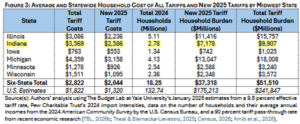
The average Indiana household paid $3,600 more because of the wave of tariffs in 2025, including $2,600 more from new 2025 tariffs alone, the UI research team finds, explaining that this is due to Hoosier “reliance on imported industrial inputs and relatively higher consumer spending shares of the economy”
The analysis notes upfront that “Midwest states are manufacturing-intensive and have large agricultural sectors, making them vulnerable to tariffs and retaliatory actions by other countries.” Indiana, of course, is the most manufacturing-dependent of any state in the nation, with 24.2% of its GDP derived from manufacturing (among Midwest states, the closest is Iowa, at 16.7%), and 16% of its workforce employed in the manufacturing sector – double the national share. Indiana is also home to the nation’s fifth largest manufacturing sector.
In addition to higher consumer prices, the study data reveals that after years of expansion, both U.S. manufacturing employment and agricultural exports contracted in 2025. Driven by tariff-induced increases to production costs and foreign retaliation against U.S. exports, the UI research team estimates that this cost the six Midwest states studied almost 42,000 manufacturing jobs and excised more than $18 billion from the region’s GDP. While all states encountered losses, Michigan and Indiana suffered the biggest hit to manufacturing employment, Iowa experienced the greatest vulnerability on agricultural exports, and the diversified Illinois economy saw the largest decline in GDP.
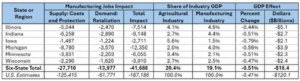
Imports account for a 20.2% share of Indiana GDP, trailing only Michigan in the Midwest. “The ‘total tariff household burden’ estimates are between 77 percent (Indiana) and 128 percent (Michigan) of these import-share estimates,” the study team posits.
The MEPI and University of Illinois PMCR analysts also find that “Across the Midwest, small-business importers paid an average of $709,000 more in Michigan, $586,000 more in Indiana, $449,000 more in Illinois, $272,000 more in Wisconsin, $197,000 more in Iowa, and $182,000 more in Minnesota, causing them to raise prices, halt hiring, and scale back expansion plans.” The national average increase for small-business importers was $306,000 – substantially lower than the burden assumed by Hoosier small businesses.
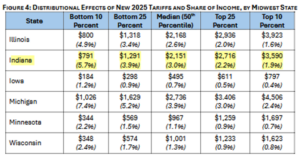
The hardest-hit group in the six-state region has been the bottom 10% in Michigan, but Indiana is right behind Michigan in terms of tariff-related impact on low-income households.
If you want to build your own calculators, the UI study team determines that the “marginal effects” – the impacts from each
additional one percentage-point hike in tariffs on household costs, factory jobs, and GDP costs the average Hoosier family $364 in added household costs, trims 1,288 factory jobs, and decreased state GDP by a 0.07% rate.
The bottom line conclusion from the report: Midwest states –with robust consumer spending and manufacturing-intensive economies – have borne significant costs from the federal government’s new tariff regime.” Digging deeper, Indiana takes a larger hit than most other Midwest states because of its significant manufacturing and agricultural output, making us particularly vulnerable to tariffs on overseas supply chains and foreign retaliation.
Note, of course, that the uncertainty of tariffs was cited by the State’s economic forecasting consultant, S&P Global Market Intelligence, in April 2025 as the reason to tamp down revenue expectations. By December, S&P changed its tune, suggesting to lawmakers that “Tariff levels and their impacts have varied by industry but generally less than feared in spring 2025,” when projections were that real gross state product would dip from 3.8% growth in 2025 to only 1.3% in 2025 . . . while it ultimately ended up growing by about four percent last year.
And, late Thursday, Hoosiers learned that the Trump Administration planned to impose a new round of widespread tariffs – 10% to 12.5% – on goods from more than 80 countries on Friday, replacing previous temporary global duties set to expire.