

Market stabilizes; winners, losers become increasingly defined
Until the pandemic hit in 2020, we had traditionally presented you a July deep dive into the mid-year casino numbers, detailing how things had progressed through the first half of the year and serving up our (modestly speaking!) virtually spot-on predictions for where the bottom line were likely to finish at the end of December.
After the unprecedented disruptions of 2020 – highlighted by three full months of pandemic-forced closures – rendered meaningful comparisons virtually impossible, we gradually resumed that tradition as the industry recovered. In recent years, however, the task has become increasingly complicated by major structural changes – including the opening of Hard Rock Casino Northern Indiana, the renovations at Indiana’s two racinos, the debut of Terre Haute Casino Resort, the growth of online sports wagering, and the continued expansion of gaming opportunities in neighboring states.
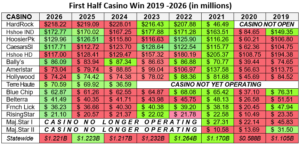
The following year we rejiggered things and at least tried to present the first-half figures within historical context, if not taking too big a leap to project (using our secret recipe) how we presumed the year would end. As we seemed to settle into a “new normal” of sorts, we reprised at least some of the tradition and offered you some perspective on the first-half 2023 numbers.
As the calendar turned to 2024, we were confronted with the new renovations at Harrah’s Hoosier Park Racing & Casino impacting numbers for the first few months. Then the mid-April debut of the Terre Haute Casino Resort and mid-May entry of its hotel into the market shook things up again.
Those elements made it difficult to compare results against January – June 2023 and draw strong conclusions for the remainder of 2024. In 2025, we were able to factor in the first full (half) year of the Vigo County casino, also skewing the numbers – along with new offerings in Illinois.
Those transformational changes have now largely worked their way through the marketplace. Indiana’s casino industry appears to be settling into a new competitive equilibrium, even if that equilibrium features a handful of clear winners . . . and a growing number of properties struggling to maintain historical market share.
So let’s examine just what the first six months of 2026 tell us.
Indiana’s 13 commercial casinos generate win of $1,221,297,764 for the first six months of 2026. This bottom line trails the $1,222,597,486 collected during January – June 2025 by a marginal $1,299,722 (- 0.11%) – or about $7,181 per day over the 181-day 2026 period. That’s about $299.20 per hour, which works out to a deficit of about $23 per hour per casino – quite marginal, as we suggested.
The 2025 first-half numbers had improved by about $5.27 million (0.43%,) over the $1,217,326,240 collected during January – June 2024, representing the first improvement since the Covid-skewed 2021-to-2022 first half. Comparing the first six months of 2026 to the same period in 2024, win is up by $3,971,524 (3.26%) over that biennium, but you must recall that the Vigo County casino did not open until more than midway through the first half of 2024, and there was no comparison yet against competition from the Chicago Southland.
The 2026 win also falls short of the $1,231,853,796 registered in 2023, and the $1,264,817,710 the commercial casinos reaped in January – June 2022.
The January – June 2023 numbers had served as the second-strongest win for the first half of any year since 2013 (trailing only the first half of 2022), when the fourth Ohio land-based casino debuted in downtown Cincinnati (and the first time we had competed against the video gaming terminals in Illinois for any January – June period).
By and large, casino revenues in Indiana have largely been stable for the first half of the year over the last three years, independent of outside factors as the industry (and it markets) have seemed to find an equilibrium of sorts. We still have not managed to return to the golden age of gaming when we topped $.4 1 billion in first half revenues for back-to-back years ending in 2010, after which land-based casinos in Ohio largely cut into our largesse, even as we moved to fully land-based options of our own beginning with Evansville in 2019.
The current five-year run of first-half numbers, however, constitutes the best such total in the past decade+, even as it continues to raises questions about why revenues are not stronger given the new and renovated properties.
Indeed, subtracting out the Terre Haute numbers in 2024, 2025, and this year as well, first-half revenues in each year would not have grown against the comparable six-month prior-year periods. This is obviously a concern.
The 13 properties report slightly greater than a 4.35% increase in semi-annual revenue compared to the Covid recovery period in 2021, and an improvement of 107.6% over the 13-property 2020 period (the two Majestic Star Casino properties were effectively traded for the Terre Haute Casino Resort and Hard Rock Casino Northern Indiana), which, of course, was effectively just one quarter and not two as casinos were dark from March 16 – June 15, 2020.
Here is how the first two quarters in previous years contributed to the final results for the full years:
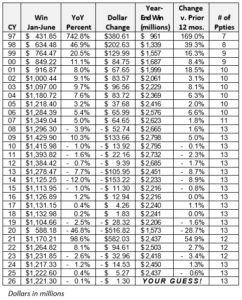
Looking back to the final pre-pandemic period, the first two quarters of 2022 generated almost 12% more revenue than in the same period of 2019, which itself had been impacted by nasty weather that forced some casino closures, as well as strong competition from Ohio. Indeed, the 2018-19 first half had seen the first downturn in January-June results since 2015. For the six months ending June 30, 2019, statewide casino win amounted to just $1.10 billion, a 14-year low . . . until the pandemic changed life as we knew it.
Since then, we seemed to have largely recovered from the pandemic, with Q1/Q2 2025 in the confirming that we were effectively back where we were before the Ohio onslaught, all things considered (such as the new Illinois and Kentucky competition and Indiana upgrades at the two racinos and moves to land-based facilities or partially into pavilions, overhauls in Gary, and a new property in the Wabash Valley).
However, the same 2026 period, despite displaying what is basically the same bottom line as we saw one year earlier, finds much more individual property disparity – albeit in a more positive direction than 2024 to 2025. The flat statewide results seem to be masking dramatically different performances among individual casinos.
Unlike one year ago, when only a handful of properties posted gains, nine of Indiana’s thirteen casinos increased revenue during the first six months of 2026, while only four experienced declines. The state’s strongest performers continue to be concentrated in Central and Southern Indiana, while much of Northwest Indiana remains under significant competitive pressure.
Only three of the 12 same-store properties grew win from the first half of 2024 to the first half of 2025, the pair of Central Indiana properties and Hollywood Casino Lawrenceburg. Over the first half of 2026, nine of the 13 properties displayed growth, including six that had slumped from 2024 to 2025. Only one casino that had improved from the first half of 2024 to the first half of 2025, Bally’s Evansville, slipped from 2025 levels during the first half of 2026.
All of the southern tier properties save Hollywood grew win from 2025 to 2026, while only Blue Chip Casino was able to perform at a higher level in the first half of 2026 vs. 2025 numbers.
Only two of the 12 same-store properties had been able to grow win from the first half of 2023 to the first half of 2024: Hard Rock Casino Northern Indiana and Bally’s Evansville. Five of the 12 casinos had reported 2023 revenue growth (vs. seven of the 11 that were open for all of the six months of 2021 and 2022 reporting growth from 2021 to 2022).
As we noted above, only four total casinos suffered over-the-year declines in win for the first half of 2026. Nine properties experienced revenue falling from the first six months of 2024 to the same period in 2025. Ten properties saw revenue slip from the first six months of 2023 to the same period in 2024, while seven properties lost traction from the first half of 2022 compared to the first half of 2023.
Looking back to the last pre-Covid year of 2019, seven of the 11 same-unit properties report lower first-half 2026 revenues than they did in January – June 2019, Ameristar Casino East Chicago, Horseshoe Casino Hammond, and Blue Chip can fall back on the 2021 opening of Hard Rock Casino Northern Indiana (vs. competition from the far weaker Majestic Star Casino properties that were open in 2019) as a huge reason for their falloff . . . but Belterra Casino Resort, French Lick Resort Casino, Rising Star Casino Resort, and Hollywood Casino Lawrence all also fall behind in their 2019 efforts
Only four properties operating during both periods displayed improvement from the five-year-old 2019 January – June numbers: The Anderson and Shelbyville properties added live table games on New Year’s Day 2019. Caesars Southern Indiana and Bally’s Evansville, both of which moved to land-based platforms, also grew revenue from the final year before Covid.
In 2022, if you excluded Majestic Star Casino and Hard Rock Casino Northern Indiana revenues from 2021 and 2022 because of the MSC closure and Hard Rock opening and dark period between the Majestic Star closure and Hard Rock debut), then the only change in ranking came from Ameristar Casino East Chicago falling by two rungs on the leader ladder from third to fifth place.
The following year, 2023, saw much more volatility, but no casino rose or fell by more than one rung on the ladder. Horseshoe Indianapolis grew one spot to second. Caesars Southern Indiana improved by one to fourth, and Bally’s Evansville bumped up one slot to seventh. Losing position: Horseshoe Casino Hammond, which dropped by one to third, Harrah’s Hoosier Park, beset by renovation frustrations, slipped by one to fifth and Hollywood Casino Lawrenceburg was off by one to eighth place. Six properties held serve over the year.
During the first six months of 2024, eliminating Terre Haute from consideration, every property maintained its respective place relative to January – June 2023, suggesting the changing of the guard is settling out and that Terre Haute’s new entry isn’t cannibalizing the already-existing properties.
January – June 2025 found Terre Haute bump up four slots thanks to more than a full quarter more of operations in the current year . . . but even absent that difference, there is other volatility higher up on the charts. Harrah’s Hoosier Park Racing and Casino overtook Caesars Southern Indiana for the first time since 2022 (and not all of that was necessarily due to the CSI closing due to spring flooding at the vulnerable site in Harrison County). Bally’s Evansville also overtook Ameristar Casino East Chicago for the first time (ever, we believe).
The largest 2026 year-to-date increase belongs to Caesars Southern Indiana, whose revenue climbed 4.42%, an increase of almost $5.0 million over last year’s pace. Harrah’s Hoosier Park Racing & Casino continues its remarkable resurgence following completion of its renovation project, improving 2.73%, while Belterra Resort (2.81%), Blue Chip Casino (2.62%), Bally’s Evansville (2.57%), Rising Star (2.57%), Horseshoe Indianapolis (1.62%), French Lick (1.59%), and Terre Haute Casino Resort (0.97%) also posted year-over-year gains.
Conversely, the state’s most significant declines continue to be concentrated among the legacy Northwest Indiana riverboat properties.
Horseshoe Hammond has now fallen 8.88% on a year-to-date basis, representing a revenue loss exceeding $11.4 million, while Ameristar Casino East Chicago is down by 8.40%, surrendering nearly $6.7 million from prior-year comps. Hard Rock Casino Northern Indiana – the state’s revenue leader—remains essentially flat, declining by less than 1 million (and just 0.40%), while Hollywood Casino Lawrenceburg slips by a negligible $177,291 (- 0.24%).
The 2026 period further finds Caesars Southern Indiana pass Horseshoe Casino Hammond for fourth place statewide, the southern property’s highest rank in recent times – and the highest that a southern tier casino has held since the CSI predecessor property, Horseshoe Casino Southern Indiana, ranked third statewide in 2017 – when it was actually a part of the Caesars empire.
The first half of 2019 delivered only two months above $190 million in statewide revenues, the fewest in any first half since 2015. Conversely, the first halves of 2021, 2022, and 2023 produced only two months with revenue south of $200 million . . . although of concern last year at this point was that in 2023, both of those months were the final two months of the first half, a back-to-back phenomenon that we had not seen since 2019.
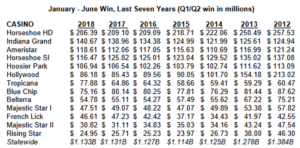
Three of the six months of 2024 fell shy of $200 million in revenue, and one of those three was June, which was the first full month of operation at full strength in Terre Haute (both the casino and hotel up and running for the entire month). Even with Terre Haute fully operational in 2025, four of the first six months of the year generate revenue short of $200 million, including the most recent (June).
In 2026, we see three of the initial six months with revenue above $200 million, and three below, an improvement from the first half of 2025.
From April – June – each month of the second quarter in 2022 and 2023 – we watched revenues decline progressively in each month. That was not unique historically; in seven of the 13 years after 2010, revenues had followed the same progressive shortfall pattern. But in only three of those seven years did year-end revenues lag the prior full-year win. In 2024, win grew from April to May (not unexpected in 2024 given that April offered only a partial month of gaming in Terre Haute). However, the decline from May to June 2024 was significant, off by $15.379 million (- 7.15%) . . . and ditto for 2025, where win again fell from March to April, and then took a big drop-off from May to June, down by $26,997,502 (- 12.13%). Win slipped again from March to April in 2026, but grew from April to May before falling again from May to June in 2026, matching the rhythm of the 2025 second quarter.
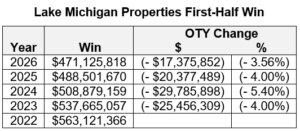
Jump-started with $408,255,680 of revenue from the trio of Lake County casinos, the four Lake Michigan properties assemble a combined first-half 2026 win of $471,125,818, the lowest of the Hard Rock era. Win is down by $17,375,852 (- 3.56%) over the same period in 2025, as win has slipped progressively since the first full year of win from the land-based Gary casino was added to the mix in 2022. Compared to that new baseline year in 2022, northern tier win has plummeted by $471,125,818 (- 16.34%) over just the past four years.
The 2025 win of $488,501,670 was down by $20,377,489 (- 4.00%) from 2024 win of $508,879,159. That number, in turn, fell by a hefty $29,785,898 (- 5.40%) from $537,665,057 in the same period in 2023, and also from $563,121,366 in 2022 (though up from $492.75 million in the first half of 2021 which cobbled together about 3½ months of gaming at the two Majestic Star Casino boats before they permanently closed down in mid-April, offering a full month of no operating casino in Gary prior to the mid-May 2021 debut of Hard Rock Casino Northern Indiana, which carried the Gary banner through the end of Q2).
Terre Haute Casino Resort has now completed its first full year of comparisons and appears to have settled comfortably into its own niche in Indiana’s gaming market. Revenue increased by slightly less than one percent during the first half of 2026, suggesting that the casino has established a stable customer base while having a less disruptive effect on neighboring properties than many (your favorite gaming newsletter not among them) had initially anticipated.
The Caesars Entertainment, Inc. Central Indiana casino couple finally tops the $300 million threshold with first half win of $302,730,041 in 2026 after approaching the figure with $296,521,979 during the first two quarters of 2025. This is up by $6,208,062 (2.09%) over the year, a more modest growth than the $13,466,542 (4.76%) improvement seen from 2025 to 2026. During the same six-month period one year earlier, the duo roped in $283,055,437 from January through June of 2024, down by $11,456,926 (- 3.89%) from $294,512,363 in 2023, but also off from $297,177,671 in the first half of 2022. The 2024 numbers were the first with fully renovated casinos at both properties for all of the first six months of 2024.
The pair of Indianapolis-area properties account for 24.79% of first-half 2026 statewide win. The share is not only an improvement from 24.25% of first-half 2025 statewide win, but it continues to grow on a progressive basis. The 2025 figure was up from 23.25% of the 2024 first-half win, from 23.91% in the prior year, from 23.50% in 2022 – but shy of 24.3% of overall state win in 2021. The racinos had been responsible for 23% of the (pre-Hard Rock) Indiana market in their last January-June without live table games. Those two Caesars Entertainment, Inc. properties continue to benefit from population growth in central Indiana, completed facility improvements, and an increasingly diversified customer base.
By contrast, the Lake Michigan market remains the state’s greatest challenge. Although Hard Rock continues to perform exceptionally well, the continuing declines at Horseshoe Hammond and Ameristar have offset much of that success. Northwest Indiana increasingly resembles two separate markets: one anchored by Hard Rock’s continued growth and another characterized by long-term erosion among the legacy properties.
Unsurprisingly, Hard Rock in Gary again enjoys the most lucrative January – June in the state – a total of $218,214,662, yet this down by $877,036 (- 0.40%) from $219,091,698 during the comparable period one year earlier. That 2025 number was down by $8,921,646 (- 3.91%) from $228,013,344 in the same six months of 2024. This, in turn, was up by $11,580,635 (5.35%) from $216,432,709 in the same six months of 2023, better than its $207,882,833 one year earlier and topping the Horseshoe Casino Hammond haul of $205.37 million in the first half of 2021 (Hard Rock debuted in May 2021).
Hard Rock’s 2024 performance served as the best first half for any casino since the Hammond property 11 years prior, in 2013, when that property generated more than $250 million during the year’s first half. Hard Rock accounted for 17.92% of overall state win from January through June 2025, down from 18.73% over the year. The Gary land-based offering generates 17.87% of all state win during January through June 2026, its lowest overall slice of statewide revenues since its full-year debut
Recall, however, that before Hard Rock entered the market in the second quarter of 2021, no casino had topped $200 million in the first half of the pandemic-affected 2019 or 2020 . . . after at least one property having done so since 2002 (when there was one fewer casino and no racinos). Indeed, as recently as 2010-12 (prior to Ohio unleashing land-based casinos), two properties topped $200 million in January through June of each of those years.
After 2022 saw us return to having six properties account for at least $100 million in revenue during the first half of the year, something we had not seen since 2014, we slipped back to just five in 2023 (with Ameristar Casino East Chicago falling less than $1 million shy of the $1900 million mark last year). Five properties had also posted first-half win in each year since 2009 . . . until the pandemic.
During 2024, 2025, and now 2026, we stayed at five properties generating at least $100 million in first-half revenue, but Ameristar falls further from that mark in each year. Indeed, ACEC has posted the state’s longest decline in first-half revenue, not having grown revenue over the prior year’s first six months since the Covid-impacted year of 2021(when all the Lake County casinos were boosted by longer pandemic limitations on gaming in Illinois.
The economic shutdown and pandemic restrictions that accompanied the reopening clouded everything for 2020 and through 2021 after the first quarter of 2020 had opened with a bang. The first half of 2021 was also impacted by the closure of the Buffington Harbor casinos and the debut of the nearby Hard Rock Casino Northern Indiana . . . following a brief dark period in Gary.
As everything appeared poised to smooth out in the first half of 2022 and return to a “normal pattern,” we were slammed by inflation (featuring high gas prices) and general economic uncertainty that seemed to impact consumer confidence . . . even as some Hoosiers benefited from the $125 per person taxpayer rebate reaching them in the second quarter.
In 2023, sports wagering changes in Illinois and the debut of sports wagering in Ohio no doubt cost Indiana casinos some foot traffic, and high gas and grocery prices may have also cut into discretionary spending on entertainment. Additional historical horse racing options in Northern Kentucky, Louisville, and astride Evansville also likely ate into first-half Hoosier revenues, but GMs should have had no complaint about Mother Nature compared to prior winters. And while Hoosier Park expansion disruptions may have discouraged some patrons, that was likely set off against the completed upgrades at its sister Horseshoe Indianapolis property.
On the negative side . . . the 2024 first half featured changes in sports wagering and historical horse racing options in Kentucky that were not in place in the first quarter of 2023, as well as inflation that arguably impacted discretionary consumer spending. Looking toward the positive, the first half of 2024 opened with Hoosier Park casino floor renovations in place, and the Terre Haute Casino Resort debuted in early April, followed by its mid-May hotel grand opening.
In 2025, consumer sentiment seemed to run on the skeptical side through the first quarter, but that didn’t appear to have much impact on casino visitation and play. We also benefited from an extra three+ months of activity at the new Terre Haute casino, and some spring flooding that impacted the end of Q1 may have been offset by heavier spend by rated patrons.
The economic conditions – inflation and gas prices in particular – may have depressed play in early 2026, along with increased sport wagering interest (thanks in part to the Indiana University Hoosiers national football championship run).
There are too many uncertainties overhanging the economy today (our Hannah News Service sister newsletter INDIANA LEGISLATIVE INSIGHT has detailed the counterintuitive Hoosier unemployment and revenue collection data over the past year that seem to defy anecdotal – and often actual – national numbers) to make any projections for year-end revenues this year . . . and we intended to bring you more granular data this summer on the link between consumer sentiment and Hoosier gaming dollars.
Given all the uncertainty in the world today, we’ll once again shy away from venturing any suggestions about just what to expect by the end of December . . . but will simply note that in virtually every case in which first-half revenues demonstrate growth over the prior year, the state ends the year with a boost in revenue over the previous year – though the most recent year, 2025, failed to adhere to that generality.
Yet we live in different times, and when the first-half revenues were down by 2.6% in 2024, we looked back at the 2.5% first-half decline in 2019 and noted that full-year figures back then had only fallen off by 1.6% (though that year saw a more typical second half after being battered by the forces of nature in the first six months), and 2023 ended up falling by 3.6% over the full year of 2022, more than we had anticipated (we suggested the state would probably be looking closer to a two percent decline, perhaps offset a bit by the second-half opening of the renovated facility in Anderson . . . a reno effort that, in our defense, ran a few months late).
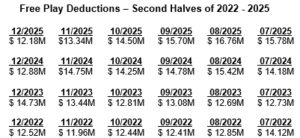
Revenues for the first half of 2023 ended up being 50.94% of the 2023 full-year total, and we’re starting to see some of the same trend lines emerge. One phenomenon we will continue to be watching is how the free play deductions will be used. In the second half of 2023, each of the final four months of the half saw a greater amount of free play credit taken than in the comparable month of 2022. Trends in use of free play were not as easily discernible in the second half of 2024 where Terre Haute was fully operational (after transferring some of its preopening credits to Hard Rock early in the year). In 2025, after taking a July to August jump (as in 2024, but not in 2022 or 2023) free play deductions dipped on a progressive line from August through year-end.
Overall, Indiana’s gaming industry appears to have entered a period of remarkable stability, one which the majority of lawmakers now serving will recognize as the status quo . . . but far different than the era of dynamic growth that solons who served before 2010 would have recognized.
Statewide revenue has remained essentially unchanged for two consecutive years despite significant competitive pressures from Illinois, Kentucky, Ohio, and continued expansion of alternative gaming opportunities throughout the Midwest.
The more interesting story is really occurring beneath the statewide totals. Market share continues to migrate toward newer and renovated facilities, particularly Hard Rock, Horseshoe Indianapolis, Hoosier Park, Caesars Southern Indiana, and Terre Haute. At the same time, several legacy riverboat properties – most notably Horseshoe Hammond and Ameristar – continue to experience sustained declines that now span multiple years.
In short, while the statewide market has plateaued, competition within that market has become increasingly intense. Indiana’s gaming industry is no longer growing through overall expansion. Gone are the days that a new casino guaranteed a significant bump in the state bottom line, and did not come at the expense of “nearby” competitors because the market had been relative unsaturated for at least two decades.
Instead, the battle today is increasingly one of market-share redistribution, with successful operators continuing to capture customers from their less competitive rivals via new bells and whistles, rather than relying upon generic growth in the statewide customer base.
That emerging pattern may prove to be the defining story of Indiana gaming throughout the remainder of 2026 . . . and well beyond as baby boomers continue to die off and younger generations seek other experiential, participatory, and sharing-option entertainment alternatives.
Check back in these pages in about 20 years for an assessment of how that’s working out when the final cohort of boomers, born in 1964 – now in their early 60s – are well into their 80s . . . and every member of Gen X will be on Medicare and qualified for Social Security benefits (based upon today’s eligibility).