
What to expect from Beau and Ballard going forward
Republicans are bracing for almost four months of Secretary of State Diego Morales (R) operating with no guardrails now that he has lost his bid for renomination after having the reelect rug pulled out from under him by those who had defended (or at least ignored) his misdeeds over the past several years of service.
His fall followed a mass exodus of former top supporters who understood that his constant stream of ethical foibles and lack of remorse was likely to cost them the office and more this fall . . . but now they have to worry about retribution against the party that could prove uncomfortable over the four months or so before election day this fall.
This is the dark cloud overhanging Republican SoS nominee Max Engling (R) as he introduces himself to voters over the next few months, while trying to convince the independent chunk of the electorate that he’s his own man, not beholden to the party leaders that installed him . . . and assuring the MAGA bloc that he can be counted on to push for closed primaries and tighter control of voting procedures.
Judging by the delegates whose support he managed to coalesce, he seems to have finessed the vast chasm between the Morales base and the former GOP controlling establishment, perhaps even beginning to forge a new post-Trump Republican ruling coalition in Indiana that is led by a Banks-Rokita alliance (Republicans have had prior success with shared leadership between prominent figures whose political interests might have been seen as potentially conflicting).
Most importantly, Republicans are ready to move on in their greater mission: saving the suddenly spotlighted secretary of state’s office against the Next Great Democratic Hope (someone should trademark that line!), Beau Bayh (D). They do this with the full understanding that, assuming he gains ballot access, former Indianapolis mayor Greg Ballard, a Republican turned quasi-independent, can do more than simply serve as a spoiler in the race.
Indeed, if Bayh – and what will likely be his record campaign spending for a down ballot Democrat in an Indiana state office race – simply adds just a handful of points to the 43% average baseline Democratic vote for SoS over the past 10 cycles (since Evan Bayh (D) won the office in 1986 with 53.3% of the vote in a three-way contest), he’ll reap about 45% of the vote.
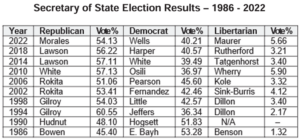
Conventional wisdom has posited that Ballard’s votes would largely come from the Republican (and would have been a much larger share if Morales had secured the nod again), but he is also likely to shave a few points from Libertarian Party of Indiana hopeful Lauri Shillings (L) (who, like Engling, hails from Hamilton County). Libertarians seem to attract two or three percent of voters who are simply voting against the two major party nominees as a protest of sorts.
The two Marines in the race, Ballard and Bayh, both reported for duty in Fort Wayne early Saturday morning, hoping to show their respective interest in picking off disaffected supporters of the losing candidate(s) as well as getting some earned media in both Fort Wayne and around the state as well.
While they succeeded in their second(ary?) objective, their delegate-cultivating efforts were likely not as fruitful as they might have been in winning over some establishment delegates for Engling had Morales (or Jamie Reitenour (R)) emerged with the nomination; a Shelton candidacy would probably have also seen the party largely unite behind him.
A 45% slice of the statewide vote for Bayh should be enough to win if the other 55% is split such that Ballard and Shillings carve out even a combined 25% from the GOP nominee. The unknown 2022 LP nominee won almost six percent of the vote by himself in that three-way race, and Engling is likely to enter the fall contest with a ceiling of the average 53.7% GOP vote for SoS (Democrats will point out that the winning percentage for Republican SoS candidates has been steadily declining since 2010).
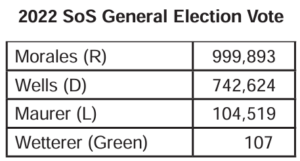
Looking at the real number of votes, Morales won the 2022 general election by about 257,000 votes over Destiny Wells (D), who in her first run for office carried none of the baggage she subsequently picked up in her 2024 and 2026 races (and for state party chair in between). The Libertarian Party candidate captured almost 105,000 votes as an unknown and spending no cash. And, oh, yeah, the Green Party landed a nominee on the ballot as well, who picked up fewer votes in the general than Reitenour did at convention. Commentator Rob Kendall suggests that if Ballard and Shillings can triple that figure (and it all comes from Engling’s bottom line), then “Bayh has to flip 25,000 2022 Republican votes to win. Not all that much,” he believes . . . though it could be difficult to peel off that many more votes from Engling than had already been won over by Ballard or Shillings. And, if you look to increasingly purple Hamilton County for Bayh to grab those votes, you should recall that Bayh’s brother Nick only barely won his delegate race in Westfield despite the alphabetical advantage on the ballot, and Engling and Shillings both hail from HamCo.
While as recently as 2012, a candidate for governor (Mike Pence (R) won election without receiving a majority of the votes cast in the race, we don’t believe that this has happened in a race for secretary of state – or any other down ballot office – in the modern era . . . but if Ballard qualifies for the ballot, there will be four candidates seeking the post (in successive cycles, no less).
Here is your first post-convention peek at how traders on the Kalshi prediction platform perceive the fall race:
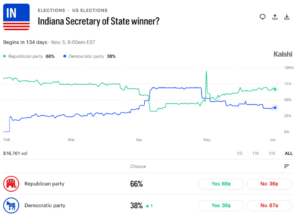
What picture does this “quantification of conventional wisdom” (as Ross Dahlke, a data science professor at the University of Wisconsin-Madison School of Journalism and Mass Communication suggests it is, different from polls, which directly ask voters for whom they plan to vote) paint of the fall contest?
Just 24 hours after Engling was nominated, the Kalshi prediction market saw some $17,000 wagered, with just about two-thirds (66.0%) expecting a Republican win to 37.9% looking towards Democrats emerging victorious . . . but the Ballard and Shillings candidacies were not part of this market.
In case you’re wondering how traders on Kalshi – who laid down $137,395 on the race! – perceived the GOP contest in the final hours, there was an interesting swing in perceived candidate fortunes as delegates began arriving in Fort Wayne Friday, June 19 and then began voting late in the morning of Saturday, June 20.
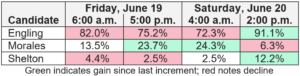
What happened at convention? The prevailing sentiment as the weekend opened was that Engling would prevail, but that confidence was subject to ebbs and flows leading up to the final ballot. The Engling floor operation (largely organized by Rep. Kyle Pierce (R), who was not to be distracted nor unwilling to perform any seemingly minor task he saw as necessary) was clearly superior to that for Shelton or Morales (Reitenour’s operation seemed to be most effective in packing up and leaving after her first ballot defeat). No one seemed to be too concerned about any floor fights over the platform or rules, and former Sen. Randy Head (R) presided over a convention floor that could easily have gone sideways if he had proven more laissez-faire.
Indeed, Head opted to lump together the vote for the two uncontested nominees, State Comptroller Elise Nieshalla (R) and State Treasurer Daniel Elliott (R) so that the actual process of voting would not drag on (as it later did for SoS).
Engling worked the Grand Wayne lobby in the morning, while Morales and Shelton were largely absent and Reitenour was present but didn’t actively seek to engage nor invite any engagement. The Engling orange shirts were the most prominent in the lobby and the floor, with few of the green Morales shirts or red Shelton shirts in evidence through the morning.
Engling signs carried messages that included “Close the Primary,” “Citizen-Only Voting,” And “Cut the Red Tape.” Reitenour buttons also advocated close primaries and paper ballots.
Security was tight, with a large contingent of local law enforcement backed up by a number of Indiana State Police troopers and an ISP explosives detail, as well as Grand Wayne Center private security. Entrances were largely sealed save a few closely monitored checkpoints in marked contrast to the Democratic confab at the Indiana Convention Center in Indianapolis where access was unfettered and security invisible (there were some rent-a-cops on hand for the concurrent ComicCon event convened next door to the Dems)
There were the usual pre-vote rumors about post-first ballot dealmaking, but none seemed to have any legs, and there were no bombshell whispers about major swings of delegation support or new or changed endorsements headed into the first round of voting. A fairly boring event, unless you were one of the candidates and you may not have trusted your math. Heck, the biggest news may have been that a sitting Republican governor and lieutenant governor (1) felt confident enough to attend, and (2) were not booed when they did.
Intriguingly, Engling went full Diego in telling the convention floor that election integrity was paramount and “The office of Secretary of State has never been more important.” He added cryptically (or in actual code, as some interpreted it) that “if we lose this office, we could lose everything else …. we must keep the chief elections officer in the State of Indiana in conservative hands.” “If they win, we will be handing over our voter rolls to the party that gave us open borders and illegal immigrant voters,” he adds.
As for Morales, he used his first address to delegates as an opportunity to launch a diatribe against the “establishment,” whose confidence and then support he had long ago lost. He recognized the predicament he had placed himself in, conceding that “I’m not perfect. There have been mistakes. But I have learned. But mistakes aside, there is no candidate better prepared.” He also airs his grievances, noting that ““Now this year comes the biggest heist of all. Everyone who endorsed me suddenly stabbed me in the back.” But, he assures the delegates, “I’m a fighter.” “The establishment never wants you to have a choice …. I did not resign. I did not step down. I am not a quitter. I am a fighter,” he reiterated, appealing to delegates to “stand with a fighter who refuses to quit, and stand against the establishment that tried to take away your voice.”
Reitenour, as we have become accustomed to seeing in her campaigns for governor and lieutenant governor, leaned heavily on religious themes. “I did not participate in the defilement of this race. Instead, I have come to wash your feet with goodness.” She added that “I have treated this campaign like a job interview,” explaining how she had researched the office and its responsibilities before running. She also outlined her proposed election reforms, including closed primaries, single-day voting, and a return to paper ballots.
Shelton pledged to use his experience as a fraud investigator to address title fraud, and leaned heavily on his boots-on-the-ground election administration experience. He noted that “I am the only candidate in this race who has run an election. I’m the person the county clerks call when they need answers.” “[W]e don’t need a show horse. We need a work horse to protect your vote,” he contended. “As your next secretary of state, I’ll use my experience as a private investigator to look beneath the surfaces …. The Secretary of State’s Office is not a beauty pageant or a beauty contest. It’s an operational machine,” and he pledged that “The Democrats will have nothing to hit me on,” despite already absorbing a number of hits from fellow Republicans in recent weeks about assorted concerns. “I am not riddled with scandals.”
Note that the total delegate count was supposed to be 1,789, so about 113 delegates (6.3%) didn’t even show up for the first ballot . . . though even if any single candidate would have been the beneficiary of all those votes, no one would still have won a first ballot victory, nor would any of the ranked-order slots have changed – and the order has a psychological impact in negotiating for votes on subsequent ballots.
We were surprised that Morales did not lead on the first ballot, and that Reitenour had a triple-number of votes. Engling ended up closer to a first ballot majority win than many had expected. While the vote tallying took a much longer time than delegates (and candidates) would have liked, we’re told by those in the vote count room there was no truth to the prominent rumor that Reitenour had requested a recount (though she delivered a seemingly lengthier and more passionate post-convention response to the claim than she had devoted to her plans for the office during the campaign).
Only 48 delegates who (presumably) participated on the first ballot failed to vote on the second ballot, which saw Engling win with a slim majority – but a hefty 15 percentage points over second-place finisher Shelton in the three-way race. As we emphasized, Morales’ first ballot total was always going to be his ceiling, and he lost 149 votes on the second ballot, more than one-half (52.65%) of his already disappointing first ballot total. In the end, only a single-digit percentage of delegates went down with Diego. Shelton picked up 84 votes on the final ballot, while Engling almost doubled that growth, counting 152 new backers in the end.
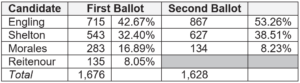
Of interest, if not importance: Morales won more first ballot votes in his 2022 convention upset of then-secretary of state Holli Sullivan (R) than he did this year, but Engling won 20 more votes on the final ballot in 2026 than Morales did in 2022 (and earned a higher percentage of votes). Morales also picked up votes between the first and second ballots in 2022, while Shelton lost votes between ballots in 2022 and picked up some in 2026.
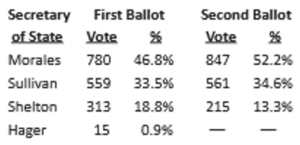
Note that these vote totals and percentages from the 2022 convention look eerily similar to the 2026 bottom line.
Democrats will be refocusing now that they know who the fall candidate will be . . . and that it won’t be the ethically challenged incumbent Morales. But that won’t stop them from typing Morales around the ankles of Engling (and Treasurer Elliott and Comptroller Nieshalla for ignoring the Morales moral failings for so long until they suddenly didn’t just ahead of the filing deadline).
Terre Haute Mayor Brandon Sakbun (D), who passed on a state run of his own this year in favor of traveling the state for Bayh and others (and building up some serious chits and a statewide knowledge base and network) has no problem going on the attack for Bayh, his peer in age (30) and military service (as a captain, he served a tour of duty in Afghanistan with the Army’s elite 75th Ranger Regiment). He took to social media nomination day to suggest that “What’s incredible is the establishment spent 4 years tolerating Diego’s antics. They replaced Diego because of polling data NOT because of morals or ethics. Now the same people in charge want to rotate in a new candidate and turn a blind eye to years of corruption.”
Democrats will also pester Engling about his call for naming a “special investigator” to review the Morales mess . . . and the longer he takes to become more specific about this, or ruling Republicans wait to look into the office now that they have dumped Diego, the more difficult it will be for Engling to run on his own.
Democrats are also somewhat relieved that Shelton did not take to the mound in relief of Morales, because Shelton’s election administration and fraud investigation experience – and running a government office – would contrast with Bayh’s inexperience in an office environment of any type. And they like the amorphous work background of Engling which can just as easily be used by Engling to establish his election-related bona fides, as by Bayh to show that his chops are merely political.
Rather boldly, Democrats also began raising money for the fall races by claiming that “Hoosiers have a choice between a longtime D.C. swamp product and a former Marine who served his country with duty and honor. Beau Bayh is the only qualified candidate in this race.” Indiana Democratic Party Chair Karen Tallian chose to frame things in much the same manner by suggesting that “When Beau Bayh entered the race for Secretary of State, Republican Party insiders were apparently scared enough to nominate unqualified male fashion model Maximillian Engling.”
“This November, Hoosiers will have a choice for Secretary of State: a Marine Corps Infantry Captain who will get in there and clean up a corrupt office, or a D.C. bureaucrat who will sweep the corruption under the rug and do whatever his party bosses tell him. Beau Bayh is the only real candidate in this race.”
Republicans will paint Beau Bayh as a non-Hoosier (despite being born in Indiana) who has none of the experience needed to run an elections-focused office at a critical time for the election infrastructure (while Democrats will insist that this is a false narrative, and that Republicans are trying to confuse things by seeking to impose additional restrictions on voting that are not needed and impede voter turnout, civic participation, and citizen confidence in government). Some Hoosiers who may prefer a more middle ground on this may be waiting and watching for candidate Ballard to weigh in.
Progressives didn’t seem to immediately flock to the Bayh camp after their preferred candidate Blythe Potter (D) lost the SoS nod at convention, and they may still be wary enough of Bayh and the establishment tradition he represents to be susceptible to Republican attacks on Bayh, or the independent figure cut by Ballard . . . or they may simply stay home given that this is the top race on the ballot. (and no congressional races – as of today – appear to be competitive to them, though Sen. JD Ford (D) hopes to convince them otherwise).
One thing voters don’t care about: the more routine daily functions of the office, including business registration, regulation of auto dealers, oversight of state securities laws, and handling notary publics. Heck, if Democrats take over the office you might see the same interest on the part of supermajority legislative Republicans to move some of the functions of the office to other agencies and entities (as they did in removing legislative lobby regulation from then-secretary of state Joe Hogsett (D) in 1992 after he announced an intention to begin more strictly enforcing portions of the law under terms – ironically – of a new Attorney General Official Opinion authored by a Republican AG to a Republican lawmaker).
Both major party candidates have spent much more time in D.C. and elsewhere in the past two decades than Ballard, who will likely seek to capitalize on this with some folksy indirect references . . . and while there will be piles of out-of-state dollars continuing to pour in to the respective coffers of the Democratic and Republican nominees, look for Ballard to largely focus upon the Indianapolis business community for his dollars (which fundraising may end up being attenuated somewhat by the Bayh family connections), allowing him to point out how non-Hoosiers want to control Indiana elections and business services.
So this will be a fascinating race, particularly if Ballard gains ballot access. Right now, Republicans seem to be obsessed with Ballard’s candidacy, and it appears from the outside looking in that they would prefer an Engling vs. Bayh race with Shillings on the margins than risk vote dilution for Engling with Ballard in the race.
The “Accidental Mayor” could become the “Accidental Secretary” if conditions remain unsettled for Republicans and he raises a credible amount of campaign money and spends it wisely. Those who remember his seemingly quixotic first mayoral campaign will recall that he went anywhere he was invited, some places he wasn’t, and played the part of the happy warrior. Little changed in his reelection bid, save for more invitations and demands on his time. We’re led to believe that he’ll be just as willing to engage on a broad basis in 2026 as he was in 2007 and 2011.
He revealed Tuesday that his campaign has now submitted at least 64,183 petition signatures to county clerks. By law, Ballard must collect 36,943 valid signatures from registered voters verified by clerks to gain access to the ballot for his Lincoln Party initiative. He plans a final statewide “Signature Saturday” event tomorrow in which his campaign will place volunteers at numerous locations around the state that voters can visit to sign petitions.
“It didn’t matter who the Republicans nominated today,” Ballard trolls after the Saturday convention vote for Engling. “There are more independents in Indiana than Republicans or Democrats, and this November they will finally have a true independent to vote for.” And Ballard won a majority in both of his two general election races for mayor, the first time over an incumbent Bayh Administration alumnus.
But Ballard shouldn’t expect all rainbows and lollipops if he’s running. The oppo research is already being cranked up on key Ballard Administration decisions such as the sale of the city’s utilities, the Blue Indy LLC pilot that was perhaps a few years ahead of its time, and more . . . as well as questioning his whereabouts between leaving office and returning, expecting to be welcomed as a savior.
In today’s supercharged environment, Republicans don’t want to lose this office and Democrats don’t want to lose what they see as their best opportunity to win a down ballot office in a decade (Glenda Ritz (D) was an unexpected fluke). With two others in the race adding to the confusion, this will be a defining election . . . but for whom or what party is far from clear today.
The prediction markets and television stations booking campaign spots will be the only certain winners as other states will look at Indiana and wonder why all the fuss over an open seat race for secretary of state, of all things.