
College-going rate up for first time in decade; still below prior years
Indiana’s college-going rate increases for the first time in a decade . . . but the rate is still lower than when it plateaued for a couple of years post-pandemic.
The state’s college-going rate for the class of 2024 is 52.2% – up slightly from the class of 2023’s 51.7% rate released last summer, which was the lowest going rate in recent state history.
The college-going rate has been on a downward trajectory since 2014, when the rate for that graduating class was 64.8 percent. Between the classes of 2014 and 2020, the rate had tumbled down to roughly 53%, and it held steady around there for the classes of 2020-2022, before it took a dip with the class of 2023.
Now, with the latest release of the class of 2024 rate at 52.2%, the Indiana Commission for Higher Education sees a positive, as this is the first time in a decade that the rate did not drop. But, it is still below that 53% rate that held steady for 2020-2022.
Brook Kile, ICHE senior associate commissioner for business solutions, presented these numbers for the first time at the commission’s May 14 meeting. She described the commission staff as “thrilled” by the increase.
“We’ve been waiting a long time for Indiana to turn the corner,” Kile enthused. “We’re looking to how this shapes our further goals for completion and attainment.”
Keep in mind that the college-going rate is a lagging indicator, as the data is two years old before the new rate is presented each year. For years, ICHE has used it as a key performance metric, but is now moving to use the going rate more as a leading indicator for completions and attainment, as Kile explained.
With that in mind, 2024 was a significant year for the commission, as it implemented many new initiatives that started with the class of 2024. The Indiana Pre-Admissions program launched in August 2023, so this graduating class was the first cohort to be a part of that.
Indiana also began the FAFSA filing requirement in the 2023-24 school year. At the same time, the class of 2024 experienced the federal FAFSA relaunch blunder that left students unable to file the form until early 2024, when the applications typically are available in the fall prior.
Further errors left colleges around the country unable to determine financial aid for months, leaving many students without aid offers until spring 2024, just as they were graduating high school. So, that could have also played a role in the going rate.
Nationwide, the FAFSA errors resulted in a 9.0% decline in submitted applications as of August 2024, or roughly 432,000 fewer applications than the previous year.
Also significant, Indiana’s college on-time completion rate surpassed 50% for the first time, jumping from 49.4% in 2024 to 52.8% in 2025. The 2025 on-time completion rate is reflected from the fall 2021 cohort for four-year schools and fall 2023 for two-year schools. The commission just launched a dashboard this month showcasing college completion data.
In gathering feedback from universities and stakeholders, Kile informed the commission that its initiatives are credited with the going rate increasing.
“They aptly said, ‘what you’re doing is working.’ Our FAFSA initiative is working, our Pre-Admissions is working,” Kile asserted.
She added, “But we also know that it’s not enough just to get the students enrolled. We need to make sure they complete. So, again, we’re really happy with this metric but definitely recognize it’s leading.”
Secretary of Education Katie Jenner also credited Indiana’s higher education institutions for working to increase college enrollment. “Our higher ed institutions have been working incredibly hard to ensure that people are aware of the value proposition that they provide. We know that there is a national spin to this, and we can only control what we can,” Dr. Jenner contended.
Now, diving into the college-going numbers for the class of 2024, the highest college enrollment rates continue to be among students who completed more rigorous academic pathways, according to ICHE’s dashboard.
Honors diploma graduates in 2024 post an 85.7% college-going rate, compared with 39.5% for Core 40 diploma graduates and 10.5% for students with general diplomas. Students who graduated without a waiver enroll at nearly twice the rate of students who graduate with a waiver, 53% compared with 27 percent.
College-level coursework also strongly tracks with enrollment. Students in the class of 2024 who took and passed an Advanced Placement test posted an 86.3% college-going rate. Those who took an AP test but did not pass still enrolled at a 74.2% rate, while students who did not take an AP test enrolled at 39.1%. Students who earned dual credit enrolled at 64.9%, compared with 31.3% for students who did not earn dual credit.
Students who earned credentials in high school also registered higher college-going rates.
Those who completed the Indiana College Core enrolled at 90.4%, the highest rate listed in the dashboard. Students who earned an associate degree enrolled at 86.7%, while students who earned another certificate enrolled at 62.6 percent. Students who did not earn a credential enrolled at 50.1 percent.
The data also shows the continued importance of the state’s 21st Century Scholars program. Students in 21st Century Scholars who graduated in 2024 enrolled in college at an 80.3% rate, compared with 49.7% for non-scholars. Economic status continues to be a barrier. Students who were not eligible for free or reduced-price lunch enrolled at 59.9%, while students who were eligible enrolled at 39.6 percent.
College-going rates also vary by race and ethnicity. Asian students had the highest rate, at 72.6 percent. White students enrolled at 54.4%, while Black students enrolled at 46.9%, and Hispanic or Latino students enrolled at 43.3 percent.
Female students continue to enroll in college at a higher rate than male students. About 59.2% of female graduates in 2024 enrolled, compared with 45.1% of male graduates.
Most students who enrolled in college in 2024 stayed in Indiana’s public higher education system. Indiana public colleges enrolled 27,810 graduates, or 35.7% of the class. Indiana private nonprofit colleges enrolled 6,300 graduates, or 8.1 percent. Out-of-state public colleges enrolled 3,849 graduates, or 4.9 percent, while out-of-state private nonprofit colleges enrolled 2,546, or 3.3 percent.
Ivy Tech Community College pulled the largest percentage of 2024 college-going high school graduates with 6,435 students, or 23.1% of Indiana public college enrollees. Indiana University-Bloomington enrolled 4,765 students, followed by Purdue University-West Lafayette with 4,192, Ball State University with 3,040, and Indiana University-Indianapolis with 2,398.
Most Indiana public college enrollees from the class of 2024 entered bachelor’s degree programs. About 73% enrolled in bachelor’s programs, while 20.9% enrolled in associate degree programs. Smaller shares enrolled in shorter-term award programs, including 4.5% in programs of at least one but less than two academic years and 1.3% in programs of less than one academic year.
The most common program area was STEM, which enrolled 6,998 students, or 25.2% of public college enrollees. Business and communication followed at 18.2%, health at 17.7%, social and behavioral sciences and human services at 10.9%, arts and humanities at 9.2%, trades at 7.2%, education at 6.2%, and undecided at 5.5 percent.
Most students entered college full-time. About 84% of Indiana public college enrollees in 2024 were full-time students, while 16% were part-time.
The ICHE data also tracks this high school class’s performance through the first year of college. Across all 2024 graduates who enrolled in Indiana public colleges, the average freshman-year GPA was 2.9, and students earned an average of 23.64 credit hours.
Honors diploma graduates averaged a 3.3 GPA and 28.21 credit hours, while Core 40 graduates averaged a 2.4 GPA and 18.71 credit hours. General diploma graduates averaged a 2.1 GPA and 10.41 credit hours.
Students who took and passed an AP test averaged a 3.3 freshman GPA and 28.74 credit hours. Students who took but did not pass an AP test averaged a 2.8 GPA and 24.72 credit hours, while students who did not take an AP test averaged a 2.6 GPA and 20.37 credit hours.
Dual credit students also performed better in their first year. Students who earned dual credit averaged a 3.0 GPA and 24.88 credit hours, compared with a 2.5 GPA and 19.12 credit hours for students who did not earn dual credit. Students who completed Indiana College Core averaged a 3.3 GPA and 27.09 credit hours, while students who earned an associate degree averaged a 3.1 GPA and 26.26 credit hours.
Freshman-year performance also varied by income, race, and ethnicity. Students not eligible for free or reduced-price lunch averaged a 3.0 GPA and 24.99 credit hours, compared with a 2.5 GPA and 20.56 credit hours for eligible students. Asian students averaged a 3.1 GPA and 27.21 credit hours, while white students averaged a 3.0 GPA and 24.47 credit hours. Black students averaged a 2.3 GPA and 19.23 credit hours, and Hispanic or Latino students averaged a 2.7 GPA and 21.56 credit hours.
ICHE additionally breaks out the going rate by county on its dashboard. For the class of 2024, Boone County boasts the highest college-going rate at 72.3 percent. Just behind it is Hamilton County with 72 percent.
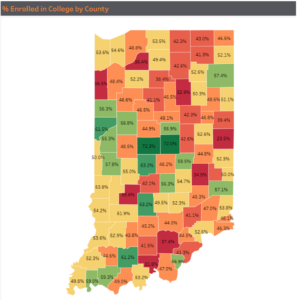 The map indicates that the more affluent suburban counties, including the donut counties surrounding Indianapolis, hold higher college-going rates. Counties with a state university presence also have higher rates above the 50% range, with Monroe County, home to IU Bloomington, holding a going rate of 63.2%, and Tippecanoe County, home to Purdue, at 58.8 percent. Counties surrounding universities trend a little higher as well.
The more rural areas of the state trend toward the lower percentages. Randolph County, a rural county on the border of Ohio, holds the lowest going rate of 23.5 percent. Other rural counties marked in the “red” on the map are Crawford County, Wabash County, Rush County, Owen County, Starke County, Newton County, and Washington County.
This is not the case for every rural county, though. Dubois County, home to Governor Mike Braun (R), boasts a 61.2% going rate (above the state average). Dubois County is home to Vincennes University’s Jasper campus, which has strong ties to the community with dual credit and technical education offerings. The county also prides itself on its German heritage, which commits residents to a both strong educational foundation and vocational excellence.
The year-over-year changes by county between the classes of 2023 and 2024 vary, with some counties seeing declines in going rates but many seeing increases, though not significant one way or the other. For example, the Boone County going rate for the class of 2023 was 73.7 percent. Franklin County, though, jumped from 54.1% in 2023 to 57.1% in 2024.