
‘All politics is local’ turned ‘All politics is national’ Tuesday
Last week we told you to think about what would constitute a win in Tuesday’s Senate primary races targeted by the White House, expecting that there would be a split of sorts that could be spun by pro-Trump or Senate institutionalists led by Senate President Pro Tem Rod Bray (R).
There’s no need to split hairs now. This was an overwhelming win for those looking for retribution. After voting against mid-decade redistricting, Senate Republican Caucus Chair Travis Holdman (R) was the first to have his race called for his opponent Blake Fiechter (R) – whom President Donald Trump (R) endorsed before he even got into the race and then briefly dropped out of the contest over concerns about the time and effort it would take, before jumping back in following an Oval Office visit.
Five more of the other eight GOP senators up for election this cycle who voted against mid-decade redistricting were also handily defeated: Sens. Dan Dernulc (R), Linda Rogers (R), Jim Buck (R), Greg Walker (R), and Rick Niemeyer (R). President Trump’s former vice president, Mike Pence (R) had endorsed Sen. Buck – a former national American Legislative Exchange Council (ALEC) chair – so the President earns bragging rights over the former Indiana governor.
The final member of the targeted pack, Sen. Spencer Deery (R), was claiming a three-vote victory on Wednesday, while his SD 23 opponent, Paula Copenhaver (R), was assuring supporters she would win once provisional ballots are counted (in Vermillion County, also in SD 23, a county council race ended in a tie).
Other Trump-backed candidates in hotly contested primaries also won: Sens. Ron Alting (R), former Rep. Jeff Ellington (R), and – apparently – Liz Brown (R) who was up by 15 votes Wednesday afternoon. She declared victory in a statement seeming to offer kind words for challenger Darren Vogt (R), but IYKYK. Vogt said a few minutes late that the race is “effectively tied,” and his campaign was “exploring all our options to ensure every legal vote is counted.”
What Worked?
We looked for every way to explain the results, and it all comes down to two things: the President and money. You could hypothesize that there was an anti-incumbent sentiment, but the only Senate incumbent outside of the targeted group who lost was Sen. Nick McKinley (R), who had filed a vacancy in January – after the redistricting vote – and only one House incumbent, Rep. Bruce Borders (R) (a redistricting and Trump supporter) failed to win renomination.
Crossing the President meant a barrage of cash was directed against the redistricting recalcitrant but and the senator “voting against Trump” was the recurring message, with the underlying theme being that the incumbent had been there too long.
That may have been a valid argument with respect to Sens. Walker (20 years), Buck and Holdman (18 years), and perhaps Niemeyer (12 years). However, Sen. Rogers was only seeking her third term, and Sens. Dernulc and Deery were freshmen, as was the sole clear survivor who denied redistricting, Sen. Greg Goode (R).
“Revenge and retribution is not a Christian value, and that’s what this was all about,” said a disappointed Sen. Holdman on election night – though a chunk of the votes against him may have emanated from those dissatisfied with the property tax reform plan he engineered in 2025 (some believing it did not offer sufficient relief; others concerned about the loss of money for schools and services), and the deciding vote he cast (after a pregnant pause) to push through the Northeast Indiana casino bill to the next stage this year. He could have voted to kill the measure that was not popular in his district, nor with some of his nearby Senate GOP colleagues.
Sen. Holdman lost big in each of the five counties in his district, with challenger Fiechter polling under 60% (almost 59%) in only one county, Jay County.
Sen. Holdman told local and national media later in the week that he had “no regrets about his vote,” and Sen. Walker added that “I made the right choice” with his vote . . . but one who did have second thoughts was a senator who voted for redistricting, even as we told you last year he had been expressing major concerns in caucus about what a vote for redistricting would mean and portend. Sen. Ron Alting (R), currently the longest consecutively serving Republican senator, issued a statement at mid-week acknowledging, “I feel terrible that I let some people down on my vote on redistricting. I hope that I’ll be able to make that up to them. But, it’s an honor, an incredible honor to represent my hometown and Carroll County,” added Sen. Alting, whose ultimate vote for redistricting earned him a presidential endorsement in what had been seen as a tough primary race for him (which he won handily).
What was clear was that the incessant negative campaigns, largely through television and direct mail, with a more modest spend on radio and digital ads, were effective in generating votes against the incumbent. Negative campaigning (still) clearly works – particularly when it is backed by a seven-figure buy in a discrete district.
“Propaganda is still a powerful tool. I didn’t have time to respond to all the just falsehoods that were printed about me and put on the air about me and so on. So, you can only overcome so much bad news,” Sen. Walker laments to the Columbus Republic. “You say a lie long enough, it becomes the truth to some people. And that’s why I feel like we were caught up in that wave. It was the retribution tool from the Oval Office. Outside money has now made its thumbprint on the Indiana Statehouse, and I think we’re all worse for it,” Sen. Walker adds.
Bluffton City Councilor Blake Fiechter (R) in SD 19 tells NOTUS before the primary that “he’s basically been a face for someone else’s campaign. ‘They are doing their messaging based on probably things that they are seeing, or they know that I probably have no clue about,’ he said of the advertising campaign on his behalf from Trump-aligned groups.”
On a primary night, Dr. Brian Schmutzler (R), the successful challenger in SD 11, exclaimed about the President, “He’ been awesome, his office has been awesome, and I thank him not only because he didn’t have to do this but that he cared enough about this race to say, ‘Hey, I’m going to support this guy I’ve never met from nowhere Indiana. I really appreciate his support and would love to have his support in the general.”
All of the challengers, save Copenhaver and Rep. Michelle Davis (R), were largely unknown. The ads helped raise their minimal name ID, but more importantly generated animosity against the incumbent. These were largely not votes for the specific challenger outside of some for Davis and Copenhaver, but rather votes against the incumbent for which the challenger was the fortunate beneficiary.
While there wasn’t much of a ground game by some of the groups who are claiming victory (principally Turning Point USA and some of its prominent champions; TPUSA seemed most active in the Goode race in Western Indiana) the money was a huge factor, backed by what Ad Impact found to be more than $13.54 million on television, more than $10 million of which was directed against the eight incumbents. Add in big bucks spent on mailers and digital ads, and you have more money spent on these isolated Senate races than was spent on the general election for governor in 2024 – even before you tally spending by the candidates themselves (what used to be the principal means of financing such races is now effectively an afterthought), which was dwarfed by the PAC and independent expenditures.
Much of the money came from the two political committees affiliated with U.S. Sen. Jim Banks (R), who served in the Senate Majority Caucus with Sens. Buck, Holdman, Niemeyer, and Walker . . . the Club for Growth run by former U.S. Rep. David McIntosh (R) . . . a White House affiliated PAC run by Marty Obst . . . and some from the Governor’s Hoosier HOPE PAC.
Sen. Banks was also a big winner thanks to being the biggest donor, and bringing aboard White House-affiliated political operatives to oversee the Indiana effort on his behalf.
“Everyone in Indiana politics should have learned an important lesson today: President Trump is the single most popular Republican among Hoosier voters. Indiana is a conservative state, and we deserve conservatives in our State Senate who have a pulse on Republican voters,” Sen. Banks posted on X primary night.”
What Sen. Banks referred to was why the national cable networks were continuously and breathlessly reporting the individual race results for effectively the first full hour after the polls closed, with their pundits weighing in on what the Indiana results implied for the renewed national redistricting fight and the remaining primary elections (bottom line: don’t cross the President).
Sen. Banks’ post continued, “It was an honor to be entrusted by President Trump with the important political work of electing conservative Republicans who support his agenda, and I’m proud to say that we delivered. I look forward to fighting for an America First agenda in Indiana alongside the many newly elected conservative State Senators. Now, we can turn our attention to the hard work of the general election, and putting as many Republicans in office across the state as possible,” he adds.
Still, Sen. Banks tells Kayla Blakeslee on WOWO 1190-AM’s Fort Wayne’s Morning News, “There’s a lot more here than redistricting. These are the same types of state senators that go to their district during elections and talk like conservatives, and then they go to the statehouse and … vote to raise taxes.” He adds that the voters made clear that “You can’t ignore them. And when you do ignore them, you’re going to lose.”
Sen. Banks and Attorney General Todd Rokita (R) also poured money into the apparently unsuccessful race against Sen. Brown (“If Liz Brown wins, it’s only because of the Trump endorsement,” Sen. Banks tells WOWO’s Blakeslee), and Sen. Banks was on the wrong side of an open seat House race in Kokomo where his preferred candidate, Kokomo Common Council President Ray Collins (R), lost to Paula Davis (R), who had been backed by AG Rokita and Lieutenant Governor Micah Beckwith (R). And while Sen. Goode, a top aide to U.S. Sen. Todd Young (R) won re-election, Banks aide Vogt appears to have fallen just a few votes short of Sen. Brown.
What about the other factors we told you to watch for?
Implications for Sen. Bray, the Senate, and the House
The obvious loss by the Senate institutionalists has been taken with grace by Sen. Bray, but his message is that he intends to stand for re-election as Senate leader and will continue to help guide his caucus to do what is best for Hoosiers.
Some might suggest that it’s a bit tone-deaf of him to present himself as a candidate for leader again, such as Governor Braun, who took to WIBC 93.1-FM Wednesday morning to tell host Tony Katz that Bray should step down from leadership. The Governor considers the primary results “a harbinger,” oddly labeling Sen. Bray “a wet blanket.” On another segment of the show, AG Rokita suggests to Katz that Sen. Bray will not likely be in leadership going forward.
“It was a good night, however you measure it,” Governor Braun tells Angela Ganote of WXIN-TV FOX59 Wednesday morning.
A few hours later, the Governor was asked by the media about whether he would support a change in Senate leadership.
I think what I would take from that is, you not only misread what to do on a redistricting, but you may look at what you’ve been doing over the last few years, and in the year and four months I’ve been here, I’m trying to take Indiana to a level we haven’t seen before. And of course, the roadblock is generally in the Senate. It was that way when property taxes were the biggest issue – complaints across the state. Well, you get a Senate Bill 1, and then it’s completely gutted by the same chamber that gave it to you. So I think that was a that was probably a bad first impression. I just want legislators that are willing to address all these cost of living issues, that are willing to take on big healthcare – which they ran against me when I came in – and most of that was watered down again by a lot of what happened in the Senate. So if we want to really get things done in this state and take it to places we haven’t seen before, we got to be enterprising, not a place where good ideas die.
So does he back a change in leadership?
I said all along that if you’re not doing things in a way that are going to make lives for Hoosiers better, that you can’t stick with the same old game plan. So I’ll let them work that out on their own. And, after last night, I think it gives them the option of having new leadership if they choose to get it.
But there are also rumblings about how Democrats could cross party lines to back Sen. Bray for pro tem if an objectionable leader candidate is offered by Republicans (recall that the Senate GOP leaders since the early 1980s have all effectively been pragmatic institutionalists).
But we’re getting ahead of our skis here.
Recall that we told you last week that it would be more important to Sen. Bray as to who the individual candidates nominated would be rather than the quantity of new senators (or potential new senators; the new nominees – including those from districts unaffected by the redistricting vote – must still win a general election).
Several of the individuals replacing incumbents are not the proverbial “bomb-throwers” – those who would not be disposed to backing Bray. If you look at the backgrounds of and rhetoric from some of the winners (virtually all of the Trump-backed candidates remained largely mum about their own individual agendas and views on issues), Dr. Schmutzler in SD 11, Bluffton City Councilor Fiechter in SD 19, Tipton County Commissioner Tracey Powell (R) in SD 21, and even Rep. Michelle Davis (R) in SD 41 should be more disposed to respecting the process than others.
While Trevor De Vries (R) in SD 01 and Jay Starkey (R) in SD 06, and former Rep. Ellington in SD 39 (who defeated Kristi Risk (R), an employee of Lt. Governor Beckwith who was favored by the Bray Team) might be more problematic, Sen. Bray apparently avoids having to finesse Brown challenger (and Banks staffer) Darren Vogt in SD 15 and could potentially gain another institutionalist if former Sen. John Ruckelshaus (R) – who defeated former Sen. Mike Delph (R) – wins the currently Democratic open seat in SD 29. While Dr. Juanita Albright, the former Hamilton Southeastern Schools school board president (and sister of former Sen. Carlin Yoder (R), the state’s most recent Trump campaign chair) may not have been Bray’s preferred nominee in open seat SD 41, he did not end up with grassroots conservative Travis Hankins (R) . . . and Democrats nominated Marion County Sheriff Kerry Forestal (D), whose law enforcement background (he is also a former U.S. Marshal) and more moderate stances on issues may be appealing in the increasingly purple district, meaning Dr. Albright might not even win in November when she has to face a broader electorate.
You should also recall that Sen. Holdman – now viewed as a key Bray ally – ran against him for pro tem Back in the Day, only to eventually join the team. Then-Sen. Mark Messmer (R) also started out waging his own pro tem effort before joining the Bray team as majority floor leader. Since then, no Bray allies have taken a swing at him, nor have others like Messmer after he was deposed and Sen. Bray elevated Sen. Chris Garten (R) to the majority floor leader post, helping to boost his own standing with potential caucus dissidents. He also showed that he had the backs of the caucus majority, and didn’t discipline those who were in the minority on the redistricting vote.
The bottom line: we haven’t counted the votes yet, but those who might believe the primary results pave the way for Sen. Garten to become the new pro tem should take a deep breath. That might ultimately happen, but it’s certainly not a done deal today.
Should he become the Senate leader, we would expect him to take on the health insurance industry with a vengeance in 2027, with an eye toward running for governor or U.S. Senate in 2028, incumbents be damned.
House Speaker Todd Huston (R) also has to be concerned. He has seen how outside forces out of his control can change the composition of a legislative body.
He has been successful to date in managing expectations of some of the antsier new members of his caucus and bringing them aboard (e.g., Reps. Becky Cash (R) and Lorissa Sweet (R)), but some of that prowess was due to reminding his caucus that some of their bolder ideas would not pass muster with the stodgier Senate pragmatists. That backstop may no longer be an argument that Speaker Huston can employ to keep his members in line . . . and could be further complicated depending upon what his caucus membership looks like after the November elections.
The primary seems to have worked out about as well as could be hoped for the Speaker, given that he was able to secure the renomination of House Republican Caucus Chair Greg Steuerwald (R) against what had been a high-profile challenge by Indiana Diverse Truckers Association leader Sid Mahant (R) and his deep pockets. Rep. Steuerwald and the caucus spent a ton of cash, but he ultimately won with 75% of the vote.
House Committee on Ways and Means Chair Jeff Thompson (R) also seemingly faced a difficult race (though few outside the district could even name his opponent), but he also won handily after a major radio and television spend in the final weeks, with no such presence by his opponent.
When you look back at the final week House Republican Campaign Committee contributions we highlighted last week, Rep. Steuerwald received more HRCC money than any other incumbent and won, while Rep. Borders was the sole incumbent to lose – not a surprise after he failed to accrue even 40% of the GOPrimary vote in the district two years earlier, previewing the likelihood that HD 45 Repubs would Return to Sender the General Assembly’s only Elvis impersonator.
A House without Borders is probably not of much concern to leadership, however, because he was defeated by Knox County Commissioner Kellie Streeter (R), the 2024 board president of the Indians County Commissioners. She’s well-known and respected by her statewide colleagues, and understands State House politics. She also ran for the HD 45 seat in 2024, finishing with 34.6% of the vote, about 320 votes behind Rep. Borders and his 38.0%, but outpacing the 27.4% carved out by former Rep. Ellington (R) – who is now poised to become Streeter’s senator after his open seat SD 39 primary win Tuesday over fellow county party chair Risk.
In open seat SD 70, longtime Harrison County Republican Party Chair Scott Fluhr (R), the HRCC-backed hopeful, won with 68% of the vote. Darrell Neeley (R) won a closer (54%) open seat HD 72 race over former Floyd County Republican Party chair and later Floyd County commissioner Shawn Carruthers (R). In open seat HD 63, Amy Kippenbrock (R) earned 77% of the vote after HRCC help, and HRCC also backed Wayne County Sheriff Randy Retter (R) in open seat HD 56, a race he won with 53% of the vote.
So while it was a good day for Speaker Huston (Rep. Jim Pressel also won easily despite some early worries), the road to governance in the House doesn’t get any easier for him.
The General Election
We’ve hinted at some of the general election races to watch. Republicans have a shot at recapturing SD 29, the seat vacated by Sen. J.D. Ford (D) as he runs for Congress in CD 05. That’s an increasingly blue seat that likely would have stayed blue if former Sen. Mike Delph (R) had won the nomination, but former Sen. John Ruckelshaus (R) is a comfortable fit for the moderate Boone County and Carmel GOP portions of the district, and he has deep ties to Pike Township in Indianapolis. The Democratic nominee in the three-way race, Kristina Moorhead (D) is a former state Medicaid official.
Both SD 29 nominees are former Indianapolis denizens now living in Carmel. Moorhead, who earned the endorsement of the Indiana Chamber of Commerce’s political arm in the primary, defeated two Black opponents in the primary, and must work hard to win the support of that community in county which has been targeted for a major increase in Black turnout before the 2027 mayoral primary.
The SD 31 seat from which Sen. Kyle Walker (R) is retiring is also increasingly moving from red to purple – and high-income. A Fishers Democrat failed to beat Sen. Walker, a Lawrence Republican, in 2022, but the scenario is flipped this time out, with Marion County Sheriff Forestal running against Dr. Albright of Fishers. Forestal defeated opponents from Hamilton County in the primary, while Albright – even running against another elected official from Fishers – still won her race despite a popular alternative from Lawrence poised to benefit from three Fishers candidates splitting the Hamilton County vote.
Albright will unite the SD 31 MAGA base, but that may be a decreasing proportion of the district. Forestal is a non-threatening law-and-order Democrat who could appeal to those in Lawrence and HamCo who don’t want to see the “downtown crime” migrate further north than 40th Street.
Beyond these two districts, looking at the playing field as of today, the opportunities for either side to flip a seat are minimal.
The only place that Democrats might have a shot at converting one of the seats won by a Trump-backed challenger is SD 0, where Sen. Dan Dernulc (R) lost to Trevor De Vries. De Vries may by a but too MAGA-oriented for marginal voters in the southwest Lake County district – which Dernulc won from then-Sen. Michael Griffin (D), who was caucused-in just nine months before the general election in 2022 (the seat became more Republican in the 2021 redistricting). The district has seen lots of recent investment and an influx of residents from Illinois, but still covers a chunk of rural territory north of U.S. 231 and south of U.S. 30.
Life-long Lake County resident Scott Houldieson (D) won the Democratic primary. He’s a nationally recognized union reform leader, organizing within the United Automobile Workers of America (UAW), and close with members of the United Steelworkers Local 7-1 and the Teamsters in a district in which organized labor still can play a significant role (particularly in North Township and Calumet Township). He’s running on a “working people” agenda, and contends that “DeVries has spent his career working against them. Northwest Indiana doesn’t need a State Senator who was chosen and funded by Washington insiders. They need someone who understands the challenges folks are facing.” The Houldieson agenda is a strong pro-labor agenda, which resonates in the northern half of the district.
De Vries works in transactional risk insurance, and describes himself as “an America First conservative running for Indiana State Senate District 1, dedicated to protecting faith, family, and freedom – and putting Northwest Indiana and America first.” The primary initiative he spells out in his campaign platform: “Protect God-given rights. Cut red tape. Stop waste. Put Hoosiers – not bureaucrats and foreign interests – first.”
Look for De Vries to downplay the Houldieson talk of him dancing the D.C. dance by reiterating what he said election night: the Trump endorsement “helped seal the deal and showed Indianapolis what real Hoosiers wanted.”
Beyond 2026
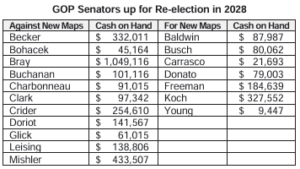
As for looking ahead politically . . . while eight GOP senators who voted against mid-decade redistricting were on the ballot this year, there will be 11 in this silo in 2028 (though we would not be surprised to see as many as seven not seek re-election due to reasons outside of the redistricting vote). We don’t know to what extent, if any, the White House or others will target these senators; President Trump will not be standing for election next year, and we don’t know whether any of those groups (or Sen. Banks or Governor Braun) will actively oppose them with the same kind of vehemence as we saw with the 2026 cohort. Here are the senators up for re-election in 2028, along with their campaign cash balances as of December 31, 2025:
As you can tell from the 2026 primary results, as well as the age and health of some of the GOP senators who seats are up for election in 2028, the Senate will be a very different place come 2029. But what about in 2027?
Even before the general election, we know that six committee chairs (and Sen. Eric Bassler (R), chair of the Committee on Appropriations Subcommittee on School Funding) will not be returning in 2027:
Committee Current Chair
Environmental Affairs Niemeyer
Ethics Bassler
Family and Children Services Walker
Local Government Buck
Pensions and Labor Rogers
Tax and Fiscal Policy Holdman
That’s a big turnover. And there will likely be additional changes by virtue of moving some current chairs into different posts to fill these vacancies.
The Committee on Environmental Affairs loses its chair and three more GOP members; Family Children Services loses both its chair and Democratic ranking member; the Committee on Local Government loses its chair and two other members; the Committee on Pensions and Labor loses its chair and two other members; the Committee on Public Policy loses three members; the Committee on Rules and Legislative Procedure loses three members; and the Committee on Tax and Fiscal Policy loses its chair and two other members.
Should the apparent election night victory of Sen. Deery be reversed, committee rosters would be further decimated.
Hoosier Republicans Going Foward
On a broader basis, what does this mean for the Indiana GOP?
We’re not sure.
Former Rep. Mike Murphy (R), also a former Marion County Republican Party chair, discouragingly tells WXIN-TV FOX59 that he does not see this as the end of a Republican Party civil war, but rather the beginning of one.
The Trump imprimatur still carries weight among the base. However, no one can be sure how long this might remain true, and with shrinking approval ratings and rising economic woes, the Trump label could prove a burden in the general election.
“Trump’s Hollow Indiana Victory” was the headline of a Thursday Wall Street Journal editorial, which observed that “He’s still king of the GOP, but it may soon be a smaller kingdom.” “Mr. Trump’s approval rating is grim. But hey, he can still rule in Indiana primaries,” the editorial concludes.
And there was this from GOP strategist Karl Rove in his Thursday WSJ opinion piece:
So what was gained by all this? Republicans spent money on intraparty payback that could have helped defend at-risk Republicans and defeat vulnerable Democrats. And to no immediate effect on redistricting. Indiana won’t redraw its maps this year. The winning primary candidates still face a November general election before they can go to Indianapolis next year and craft new congressional districts for 2028.
The stunt did reinforce Mr. Trump’s reputation for being willing to get even if he doesn’t get his way. Indiana’s Gov. Mike Braun and U.S. Sen. Jim Banks aided the effort to knock off the legislators. Maybe that makes all three of them stronger, maybe it doesn’t. Either way it will leave scars among Indiana Republicans.
Presidential endorsements invariably carry weight, but the power isn’t unlimited. When used too freely against one’s own party members or in open contests, they can weaken rather than strengthen a president.
Despite what Rove might think, Sen. Banks has certainly seized the moment to declare victory and position himself as the heir to the Hoosier Trump mantle, and he appears to be more politically powerful – or at least more formidable – than Gov. Braun, who failed to do much beyond some initial rhetoric and allowing his affiliated PAC to play with some limited cash . . . though he realized that he had to live and work with Sen. Bray and other returning senators if he wanted to advance any agenda in 2027 and 2028. Sen. Banks (who also is not up for re-election until 2030) has no such concerns.
The Indiana GOP has not yet been forced to find the delicate balance between being too focused on MAGA principles and its principal, President Trump, because the two have effectively been one in the past decade. But as the Trump term nears an end, and the Trump brand loses support outside the core Republican base, Hoosier Republicans must discern how best to retain and energize that 30% or so core, while not alienating the broader general election base. Going forward, this could prove a tall order. We’ll see in November if Hoosiers begin to show concern about Republicans being too beholden to the base.